

What Is a Pressure Sensor? Common Sensing Principles, 5 Measurement Types, and Applications
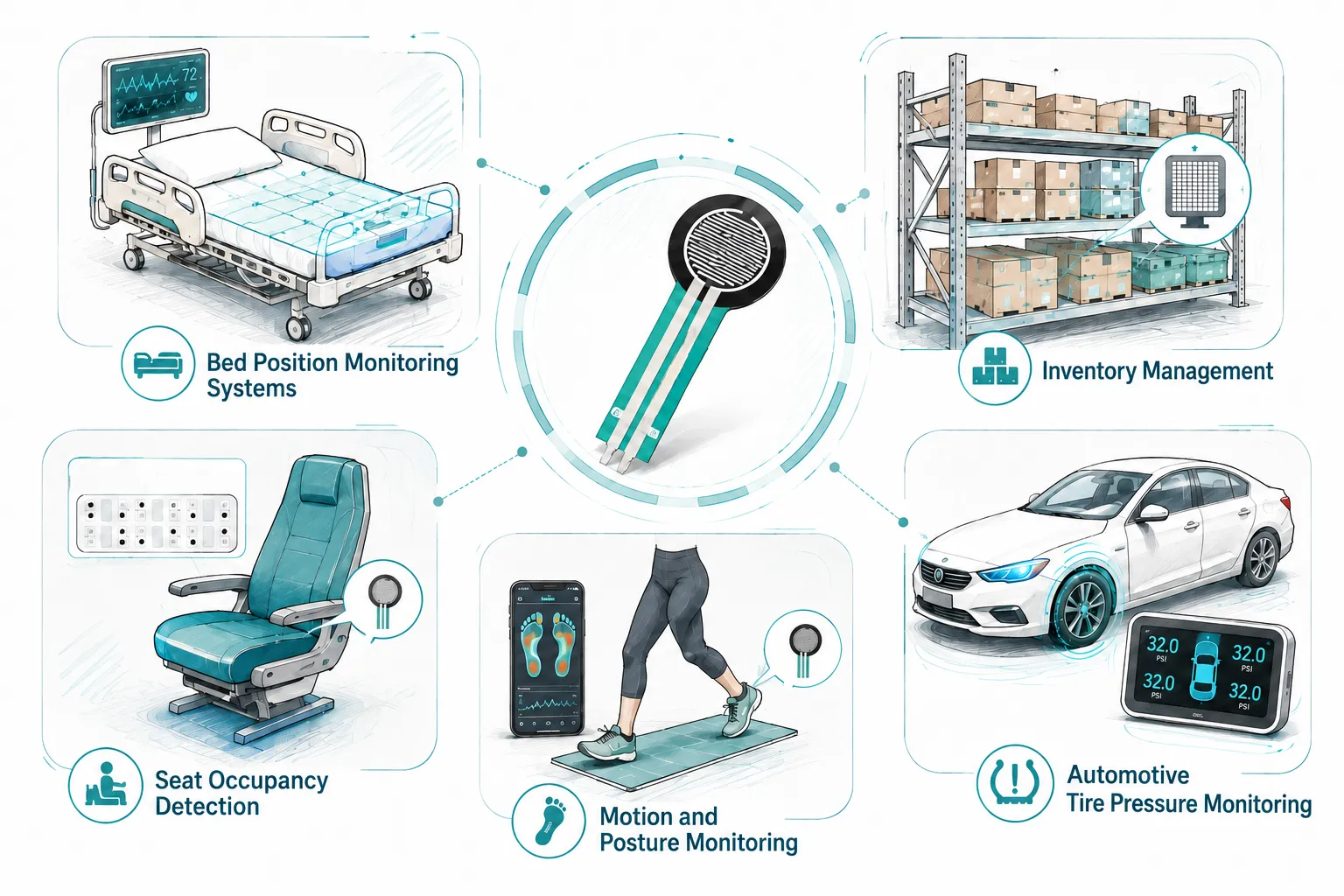
Across industrial equipment, automotive systems, healthcare applications, and wearable devices, pressure sensors are widely used for pressure monitoring and force detection. For engineering teams, pressure sensors can directly affect signal stability, control accuracy, and mechanical integration. For procurement teams, sensor selection also involves specification compatibility, service life, supply stability, and potential risks during mass production.
This article covers the fundamentals of pressure sensors, the definitions of thin-film pressure sensors and force sensing resistors (FSRs), two major pressure sensing principles, five pressure measurement types, key application areas, and six selection criteria. It is designed to help businesses make faster, more informed decisions during product development, component selection, and supplier evaluation.
What Is a Thin-Film Pressure Sensor? Understanding FSRs and the Differences Between Single-Point and Matrix Sensors
Thin-film pressure sensors can be classified as single-point or matrix sensors based on their sensing area and structure. The following section explains the basic principles of FSRs, how they differ from conventional pressure sensors, and the applications best suited to each type.
What Is a Thin-Film Pressure Sensor / Force Sensing Resistor (FSR)?
FSR stands for Force Sensing Resistor, a type of thin-film force-sensing component. FSRs are thin, lightweight, and flexible, and their size, shape, and sensing area can be customized to meet different application requirements. When pressure is applied, the contact state of the internal conductive materials changes, causing the resistance to decrease as the applied force increases. A control board or voltage divider circuit can then read this change to determine whether pressure is being applied and how the force changes.
Thin-film pressure sensors are primarily used to detect surface contact and applied force. Their thin and flexible structure makes them suitable for space-constrained applications or mechanisms that require installation on curved surfaces. Common applications include buttons, seat cushions, insoles, grips, wearable devices, and rehabilitation equipment.
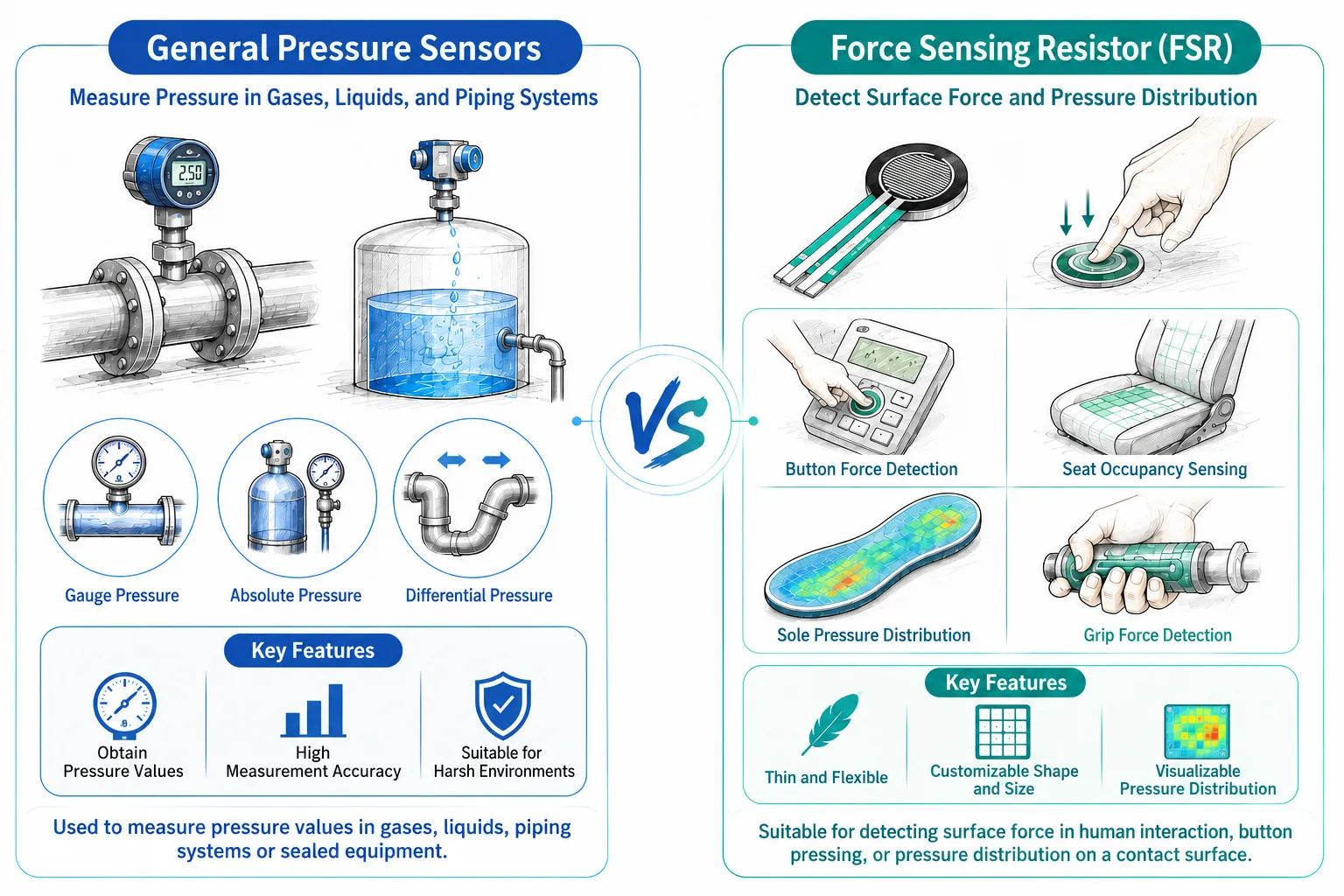
Unlike conventional pressure sensors designed to measure the pressure of gases, liquids, or piping systems, FSRs are better suited for detecting contact status, applied force, and force distribution.
What Is the Difference Between Thin-Film Pressure Sensors and Conventional Pressure Sensors?
The main difference between thin-film pressure sensors and conventional pressure sensors lies in what they measure. Conventional pressure sensors are typically used for gases, liquids, piping systems, or sealed equipment, with the primary purpose of measuring pressure values such as gauge pressure, absolute pressure, and differential pressure.
Thin-film pressure sensors, on the other hand, are designed for surface force detection and are well suited for monitoring human contact, button-pressing states, changes in sitting posture, or plantar pressure distribution.
If an application requires fluid pressure measurement, a conventional pressure sensor is generally the appropriate choice. If the goal is to determine whether force is being applied, detect changes in force, or identify areas of concentrated pressure, a thin-film pressure sensor / Force Sensing Resistor (FSR) may be a more suitable option.
What Is a Single-Point Thin-Film Pressure Sensor?
A single-point thin-film pressure sensor has one primary sensing area and is designed to detect changes in force at a specific location. Common applications include electronic buttons, limit switches, grip sensing, seat occupancy detection, and trigger mechanisms in medical assistive devices.
These sensors have a relatively simple structure and lower cost, making them suitable for determining whether pressure is applied at a fixed location. However, a single-point sensor can only detect the overall change in applied force and cannot determine whether the pressure is concentrated at the center, edge, or another position within the sensing area.
What Is a Matrix Thin-Film Pressure Sensor?
A matrix thin-film pressure sensor consists of multiple sensing points arranged in a grid. It can simultaneously detect force changes at different locations and generate pressure distribution data. Typical applications include plantar pressure analysis, smart insoles, seat pressure mapping, medical mattresses, rehabilitation equipment, and multi-point touch interfaces.
If an application only needs to determine whether pressure is applied at a specific location, a single-point sensor is generally sufficient. If the application needs to identify where pressure is applied, how it is distributed, or how force shifts between different areas, a matrix thin-film pressure sensor is the more appropriate choice.
What Types of Pressure Sensors Are There? A Guide by Technology, Signal, and Application Structure
Pressure sensors can be classified by sensing technology, output signal, and application structure. Different classifications affect measurement accuracy, signal acquisition methods, and the complexity of product integration.
Favor Union recommends first identifying what needs to be measured—such as gas, liquid, equipment pressure, surface force, or human contact—before determining whether a conventional pressure sensor or a thin-film pressure sensor / Force Sensing Resistor (FSR) is more suitable.
By Sensing Technology: Piezoresistive, Capacitive, and Piezoelectric
Common pressure sensing technologies include piezoresistive, capacitive, and piezoelectric sensing.
Piezoresistive sensors operate by detecting changes in electrical resistance when the sensing material is subjected to force or pressure. This is a mature and widely used technology commonly found in pneumatic systems, hydraulic systems, and industrial equipment monitoring.
Capacitive sensors detect pressure by measuring changes in capacitance caused by diaphragm displacement, which changes the distance between electrodes. These sensors offer high sensitivity and low power consumption, making them suitable for low-pressure measurement, barometers, medical equipment, and low-power devices.
Piezoelectric sensors generate an electrical charge when piezoelectric materials are subjected to mechanical force. Their fast response makes them suitable for detecting impacts, vibrations, and dynamic pressure changes. However, they are generally not suitable for long-term measurement of constant static pressure.
By Output Signal: Analog, Digital, and Industrial Standard Outputs
The output signal of a pressure sensor determines how the downstream system reads and processes the measurement data.
Analog outputs commonly include voltage or current signals such as mV/V, 0–5 V, and 0–10 V, making them suitable for use with control boards, ADCs, or microcontrollers.
Digital pressure sensors transmit data through communication interfaces such as I²C, SPI, or CAN. These sensors often integrate signal conditioning and calibration functions, making them suitable for embedded systems, IoT devices, and products designed to reduce the complexity of external circuitry.
Industrial standard outputs are commonly found in pressure transmitters, with 4–20 mA and 0–10 V among the most widely used formats. They are frequently used with PLCs, factory equipment, pipeline monitoring, and automation systems. In particular, 4–20 mA signals are well suited for long-distance transmission and are less susceptible to noise and voltage-drop effects.
By Application Structure: Thin-Film Pressure Sensors / Force Sensing Resistors (FSRs)
Unlike conventional pressure sensors designed to measure gas, liquid, or pipeline pressure, thin-film pressure sensors / FSRs are primarily designed for surface force detection. The sensing materials are typically printed onto flexible film substrates, providing a thin, lightweight, flexible, and customizable structure.
FSRs are not designed to measure fluid pressure inside pipes. Instead, they detect the force generated when two solid surfaces come into contact. For example, resistance changes can be used to detect force applied to a seat cushion, pressure under the foot, finger presses on a control panel, or contact between a mechanical component and a sensing area.
As a result, FSR thin-film pressure sensors are commonly used in press detection, seat sensing, plantar pressure analysis, medical assistive devices, rehabilitation equipment, wearable devices, and human-machine interfaces.
How Do You Choose Between Different Types of Pressure Sensors?
There is no single pressure sensor that is best for every application. The appropriate sensor should be selected according to the measurement target, type of pressure variation, installation space, signal acquisition method, and mechanical integration requirements.
The following section summarizes common application scenarios and key factors to consider when selecting the appropriate pressure sensing technology.
| Selection Scenario | Recommended Pressure Sensor Type | Suitable Applications | Key Selection Considerations |
|---|---|---|---|
| Long-term stable measurement required | Piezoresistive or capacitive pressure sensor | Pipeline pressure, industrial air pressure, pneumatic monitoring, equipment pressure monitoring | Piezoresistive sensors offer a wider measurement range and are suitable for cost-sensitive applications; capacitive sensors are better suited for low pressure, micro-pressure, and low-power applications. |
| Dynamic impact measurement required | Piezoelectric pressure sensor | Impact testing, equipment vibration monitoring, dynamic load analysis | Fast response speed, suitable for detecting rapidly changing pressure signals over short periods, but not suitable for long-term static pressure measurement. |
| Industrial control integration required | Pressure transmitter | PLC control, large factory pipelines, process equipment, remote pressure monitoring | Common outputs include 4–20 mA or 0–10 V, making them suitable for long-distance transmission and integration with industrial control equipment. |
| Thin, flexible, and conformable structure required | FSR thin-film pressure sensor | Insoles, seat cushions, mattresses, grips, control panels, wearable devices, medical assistive devices | Suitable for detecting surface force, human contact, pressing force, or changes in force at the contact surface. |
| Force detection at only one location required | Single-point FSR | Button triggering, seat occupancy detection, grip force sensing, mechanical contact detection, intrusion detection | Simple structure and signal acquisition, suitable for determining whether a specific location is pressed or whether the applied force changes. |
| Pressure location and distribution need to be identified | Multi-point or matrix FSR | Plantar pressure analysis, posture detection, mattress pressure monitoring, rehabilitation training feedback | Can identify where pressure is applied, how pressure is distributed, and whether the contact area changes, but system integration is more complex. |
| Stable, durable sensing with a wider measurement range required | Shunt-mode FSR | Industrial buttons, grip sensing, weight-change detection, general human-machine interface controls | Mature structure, suitable for general press detection and applications requiring detection of a relatively wide range of force changes. |
| Light touch or subtle force changes need to be detected | Thru-mode FSR | Precision controls, tactile feedback, medical assistive devices, robotic tactile sensing | More sensitive to low pressure and initial contact, making it suitable for applications requiring subtle tactile or force feedback. |
How Do Pressure Sensors Work? Comparing Piezoresistive, Capacitive, and Thin-Film FSR Technologies
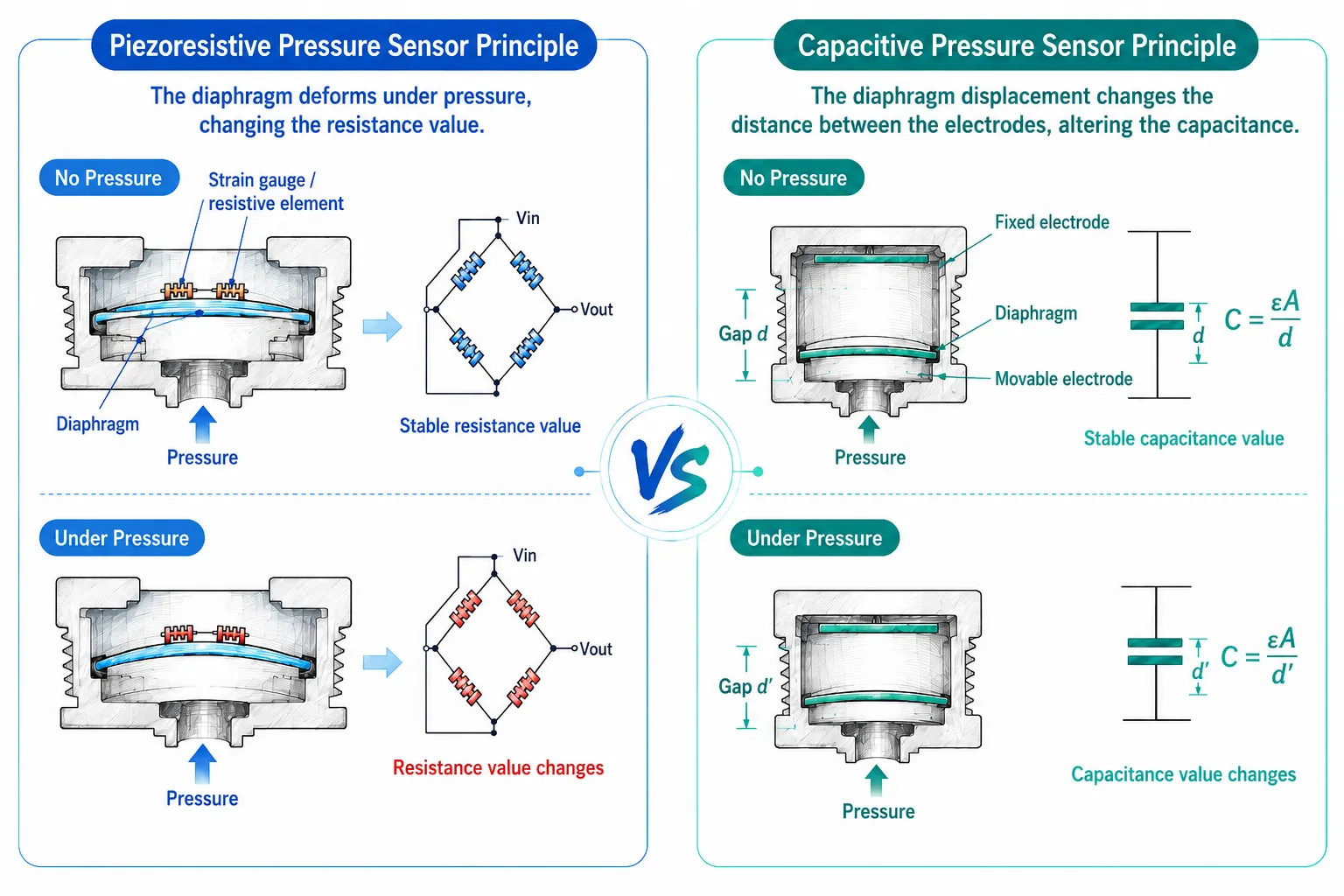
Pressure sensor operating principles vary depending on the measurement target and sensing technology. Sensors designed to measure pressure in gases, liquids, and piping systems commonly use a diaphragm to detect applied pressure, while FSR thin-film pressure sensors are primarily used to detect surface contact, pressing force, and changes in applied force.
The sensing area of an FSR typically consists of thin-film layers, conductive electrodes, piezoresistive material, and spacer layers. When force is applied, the contact conditions between the internal materials change, resulting in a change in electrical resistance. The circuit then converts this resistance change into a measurable electrical signal.
Factors such as the sensing material, film thickness, spacer-layer design, and contact area can all affect the sensor’s measurement range, sensitivity, linearity, and durability.
How Does a Piezoresistive Pressure Sensor Work?
A piezoresistive pressure sensor measures pressure using the piezoresistive effect. When pressure is applied to the diaphragm, it undergoes slight deformation. Semiconductor strain gauges or resistive elements integrated into the diaphragm are also subjected to mechanical stress, causing their electrical resistance to change.
In practical applications, piezoresistive sensors commonly use a Wheatstone bridge to detect small resistance changes. The signal is then amplified, temperature-compensated, and converted into a pressure signal that can be read by a controller. This mature sensing technology offers a wide measurement range and is commonly used in industrial piping, hydraulic equipment, pneumatic monitoring, automotive tire pressure monitoring, and general fluid pressure measurement. In environments with significant temperature variations, particular attention should be paid to temperature compensation and measurement drift.
How Does a Capacitive Pressure Sensor Work?
A capacitive pressure sensor determines pressure by detecting changes in capacitance. Its structure typically consists of a fixed electrode and a deformable diaphragm. When pressure causes the diaphragm to move, the distance between the electrodes changes, resulting in a corresponding change in capacitance.
Capacitive sensors offer high sensitivity and low power consumption, making them suitable for measuring very low pressure, small pressure differences, atmospheric pressure changes, and applications requiring low power consumption. Common applications include HVAC differential pressure measurement, barometers, medical equipment, and IoT sensing modules.
However, capacitive sensors require more sophisticated signal processing and packaging design. Factors such as environmental interference, vibration, and parasitic capacitance must be carefully managed to maintain measurement stability.
How Does a Thin-Film Force Sensing Resistor (FSR) Work?
A thin-film Force Sensing Resistor (FSR) detects contact and applied force by measuring changes in electrical resistance. Its internal structure typically consists of conductive layers, pressure-sensitive materials, and spacer structures. When no force is applied, the resistance is relatively high. As force is applied, the contact area between the conductive materials increases, causing the resistance to decrease.
FSRs are thin and lightweight, and their size, shape, and sensing area can be customized according to application requirements. This makes them well suited for space-constrained products or applications that require sensors to conform to curved surfaces. Common applications include buttons, seat cushions, insoles, grips, wearable devices, and robotic tactile sensing.
However, FSRs are better suited for detecting contact, changes in applied force, and relative force levels rather than serving as high-precision sensors for absolute pressure measurement.
Comparing Different Pressure Sensor Operating Principles
| Comparison Item | Piezoresistive Pressure Sensor | Capacitive Pressure Sensor | Thin-Film Pressure Sensor / FSR |
|---|---|---|---|
| Operating Principle | Diaphragm deformation causes a change in resistance. | Diaphragm displacement changes the distance between electrodes, resulting in a change in capacitance. | Applied force changes the contact state of the conductive materials, causing resistance to decrease. |
| Suitable Pressure Type | Static pressure and general dynamic pressure | Static pressure, low pressure, and micro-pressure | Surface contact force, pressing force, and force distribution |
| Advantages | Mature technology, wide measurement range, and relatively easy cost control | High sensitivity and low power consumption; suitable for low-pressure and micro-pressure measurement | Thin, lightweight, flexible, and customizable in size and sensing area |
| Main Limitations | More susceptible to temperature effects; temperature compensation should be considered | Higher requirements for signal processing and interference-resistant design | Limited linearity and repeatability; not suitable for high-precision absolute pressure measurement |
| Common Applications | Industrial piping, hydraulic equipment, pneumatic monitoring, automotive tire pressure, and general fluid pressure measurement | HVAC differential pressure, barometers, medical equipment, low-power sensing devices, and altimeters | Buttons, seat cushions, insoles, wearable devices, and robotic tactile sensing |
| Selection Guidelines | Consider when stable, mature technology and a wide measurement range are required | Consider when high sensitivity, low power consumption, or micro-pressure measurement is required | Consider when detecting contact, pressing force, or relative force changes is required |
How Do Pressure Sensors Measure Pressure? 5 Common Pressure Measurement Methods Explained
When measuring pressure with conventional pressure sensors, it is important to understand not only the sensing principle but also the reference point used for measurement. Even when the measured value is the same—for example, 100 kPa—the meaning of that pressure can differ depending on the reference used.
Common pressure measurement types include absolute pressure, gauge pressure, differential pressure, vacuum pressure, and sealed pressure. The selected reference affects sensor readings, installation methods, application scenarios, and sensor selection.
It is important to note that these five classifications primarily apply to gas, liquid, and piping pressure measurement. Thin-film Force Sensing Resistors (FSRs) are mainly used to detect surface contact, pressing force, and changes in applied force, and are generally not classified by absolute, gauge, or differential pressure.
(1) Five Common Pressure Measurement Types
Absolute Pressure
Absolute pressure uses a perfect vacuum as the reference point. Since a perfect vacuum is considered zero pressure, absolute pressure measurements are not referenced to local atmospheric pressure, making them suitable for applications that require a fixed pressure reference.
Absolute pressure measurement is commonly used in weather monitoring, aircraft altimeters, vacuum chamber monitoring, and equipment requiring precise pressure calculations. At sea level, standard atmospheric pressure is approximately 101.325 kPa absolute, meaning the pressure is measured relative to a perfect vacuum.
Gauge Pressure
Gauge pressure uses local atmospheric pressure as the reference point. When the sensor is exposed to ambient air, the reading is zero. Pressure above local atmospheric pressure is considered positive gauge pressure, while pressure below atmospheric pressure may be expressed as negative gauge pressure.
Gauge pressure measurement is commonly used for automotive tire pressure, air compressors, hydraulic lines, and general industrial equipment. These applications typically do not require pressure relative to a perfect vacuum; instead, they need to determine how much higher or lower the system pressure is compared with the surrounding atmosphere.
However, gauge pressure is affected by changes in local atmospheric pressure. If equipment is used at different altitudes or under varying weather conditions, the effect of atmospheric pressure changes on measurement results should be considered.
Differential Pressure
Differential pressure measures the difference in pressure between two points. A differential pressure sensor typically has two pressure ports connected to a high-pressure side and a low-pressure side, allowing the system to directly measure the pressure difference between them.
Differential pressure measurement is commonly used for filter monitoring, pipeline flow measurement, HVAC systems, cleanroom pressure control, and liquid level measurement. For example, an increasing pressure difference across an HVAC filter may indicate that the filter is becoming clogged and requires cleaning or replacement. In sealed vessels, pressure differences can also be used to estimate liquid levels.
Vacuum Pressure
Vacuum pressure is primarily used to measure pressure below local atmospheric pressure. Common applications include vacuum pumps, vacuum packaging, vacuum chambers, semiconductor manufacturing processes, and negative-pressure isolation environments.
In these applications, the primary objective is to determine whether the system has reached the required vacuum level and whether the negative pressure remains stable during operation.
Sealed Pressure
Sealed pressure operates similarly to gauge pressure, but instead of using changing local atmospheric pressure as its reference, it uses a sealed internal reference pressure within the sensor.
A common design uses standard atmospheric pressure sealed inside the sensor during manufacturing as the reference. This makes the measurement less susceptible to changes in external atmospheric pressure and suitable for high-pressure, humid, sealed, or environmentally variable applications.
(2) Application Differences Between Pressure Measurement Types
The choice of pressure measurement reference directly affects sensor selection. If the wrong reference type is selected, a sensor may appear to meet the required specifications but still produce measurement errors, installation incompatibilities, or incorrect system readings.
| Pressure Measurement Type | Measurement Reference | Affected by Atmospheric Pressure? | Common Applications | Key Selection Considerations |
|---|---|---|---|---|
| Absolute Pressure | Perfect vacuum | Generally not affected by local atmospheric pressure | Weather monitoring, aircraft altimeters, vacuum chambers, precision pressure calculations | Suitable for applications requiring a fixed reference and minimal influence from altitude or weather changes |
| Gauge Pressure | Local atmospheric pressure | Yes | Automotive tire pressure, air compressors, hydraulic lines, general equipment pressure monitoring | Suitable for determining how much higher or lower the system pressure is compared with the surrounding environment |
| Differential Pressure | Pressure difference between two measurement points | Depends on system design | Filter differential pressure, pipeline flow measurement, HVAC systems, cleanrooms, liquid level measurement | Requires two pressure ports; confirm the positions of the high-pressure and low-pressure connections during installation |
| Vacuum Pressure | Local atmospheric pressure or vacuum reference | Depends on sensor type | Vacuum pumps, vacuum packaging, vacuum chambers, negative-pressure isolation environments | Suitable for monitoring negative pressure conditions below atmospheric pressure |
| Sealed Pressure | Internal sealed reference pressure | Less affected by changes in external atmospheric pressure | High-pressure equipment, sealed environments, humid or harsh environments | Suitable for applications where external atmospheric pressure should not directly affect the sensor reading |
What Are Pressure Sensors Used For? 4 Major Pressure Sensor Applications
Pressure sensors, also known as pressure transducers, can measure pressure changes in gases, liquids, or forces applied to object surfaces, depending on their sensing structure. Conventional pressure sensors can also use differential pressure or atmospheric pressure changes to calculate flow rate, liquid level, altitude, and leakage conditions, while thin-film Force Sensing Resistors (FSRs) are better suited for detecting contact, pressing force, and force distribution. The following are four major application areas for pressure sensors:
Pressure Sensor Application 1: Automotive and Transportation
- Engine and Fluid Control: Monitor intake pressure, fuel pressure, oil pressure, brake pressure, and tire pressure to help maintain stable vehicle operation.
- Seat Occupancy Detection: Thin-film pressure sensors can be integrated into vehicle seats to determine whether a seat is occupied and provide input for seat belt reminders, occupant classification, or airbag control systems.
- Automotive Touch Interfaces: FSRs can be integrated into steering wheels, center consoles, door controls, or hidden control surfaces to detect light touches, firm presses, and different pressing states.
Pressure Sensor Application 2: Industrial Manufacturing and Automation
- Hydraulic and Pneumatic Systems: Monitor pressure in hydraulic equipment, air compressors, pipelines, and valves to prevent insufficient pressure or overpressure conditions.
- Process Equipment Monitoring: Used in injection molding, industrial pipelines, and production equipment to help ensure that operating pressure remains within a safe range.
- PLC and Factory System Integration: Pressure data can be transmitted to control systems through 4–20 mA, 0–10 V, or digital signals.
- Robotic Tactile Feedback: Thin-film pressure sensors can be integrated into robotic grippers, fixtures, or collaborative robot arms to determine whether an object has been securely gripped, whether excessive force is being applied, or whether the contact position is correct.
Pressure Sensor Application 3: Indirect Measurement
- Flow Measurement: Differential pressure sensors measure the pressure difference between two points in a pipeline, allowing the system to calculate gas or liquid flow rates.
- Liquid Level Measurement: Changes in hydrostatic pressure at the bottom of a liquid can be used to determine the liquid level in water tanks, oil tanks, storage vessels, or deep wells.
- Altitude and Elevation Measurement: Absolute pressure sensors measure changes in atmospheric pressure to estimate altitude or elevation.
- Leak and Airtightness Testing: Pressure changes within a sealed system can be monitored to identify potential leaks in pipelines, chambers, or refrigerant systems.
Pressure Sensor Application 4: Medical and Healthcare
- Wearable Monitoring: Pressure sensors can be integrated into smart wristbands, patches, or smart clothing to monitor pulse, respiration, or body movement.
- Smart Hospital Beds and Pressure Injury Prevention: Matrix thin-film pressure sensors can detect body pressure distribution, helping caregivers determine when a patient may need repositioning or posture adjustment.
- Gait Analysis and Smart Insoles: Sensors can detect force distribution across different areas of the foot for plantar pressure analysis, rehabilitation tracking, and athletic training.
- Surgical Robots and Bionic Prosthetics: Pressure sensors can provide tactile feedback to help detect contact force, gripping conditions, and changes in applied force.
How to Choose a Pressure Sensor: 6 Key Selection Criteria and Engineering Considerations
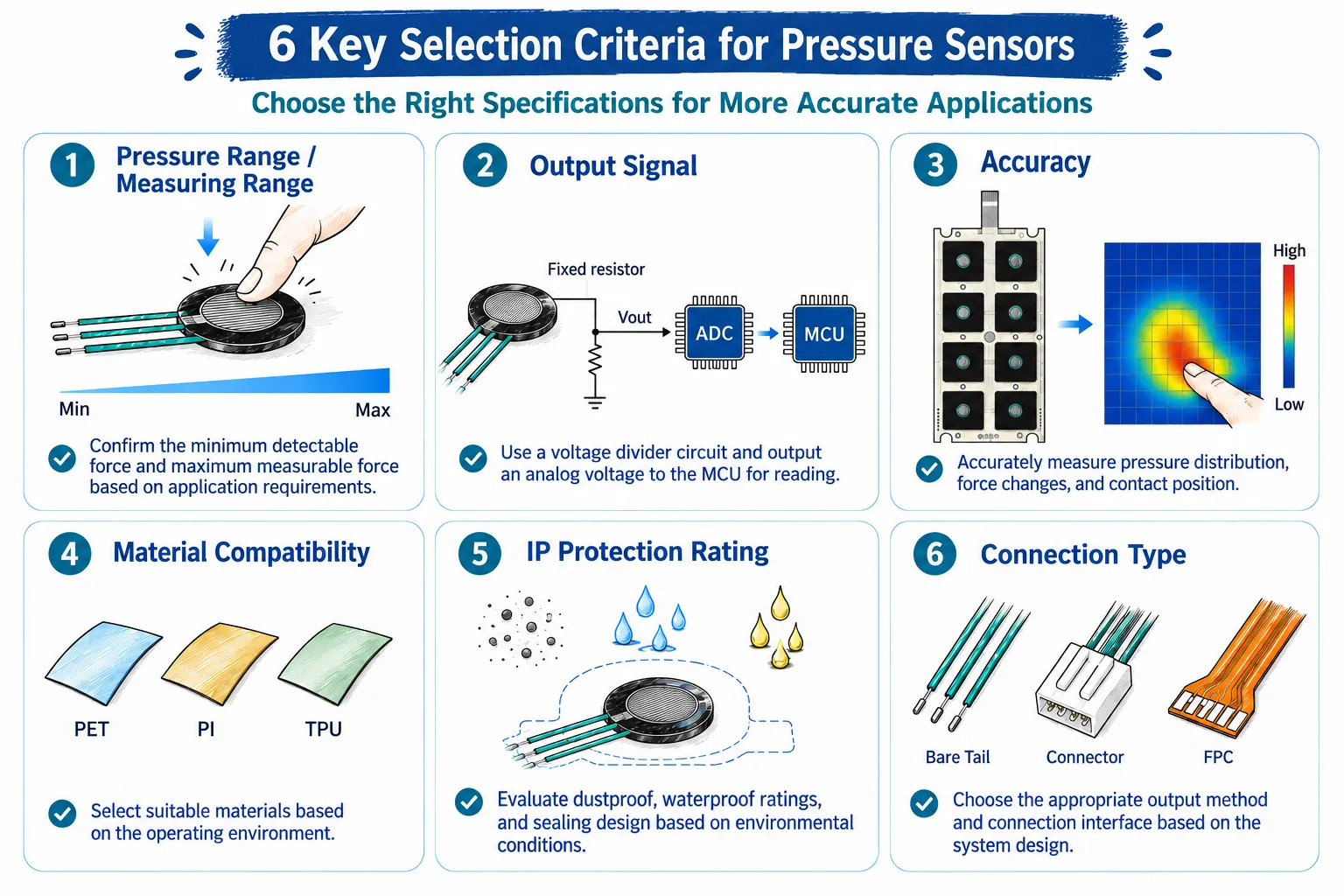
Selecting a pressure sensor involves more than simply choosing the sensing principle. Factors such as measurement range, output signal, accuracy, material, protection rating, and connection type must also be considered. These specifications directly affect measurement stability, mechanical integration, service life, and mass-production costs. Favor Union has summarized six common selection criteria to help engineers and procurement teams quickly identify suitable specifications.
Pressure Range / Force Range
The pressure range is one of the most fundamental considerations when selecting a pressure sensor. It defines the range of pressure or force that the sensor can withstand and measure. Before selecting a sensor, it is important to determine the minimum and maximum pressure expected in the application, as well as any potential momentary overloads or pressure spikes.
If the selected range is too narrow, the sensor may enter its saturation region or even become damaged. If the range is too wide, the sensor may be less susceptible to overload, but its resolution may be insufficient for measuring small pressure changes, resulting in less noticeable signal variations.
Output Signal
The output signal affects how the sensor integrates with downstream circuits and control systems. Conventional pressure sensors commonly support output formats such as 4–20 mA, 0–5 V, 0–10 V, I²C, SPI, RS-485, or Modbus.
FSR thin-film pressure sensors typically function as variable-resistance components, with resistance decreasing as applied force increases. In practical applications, an FSR is often paired with a fixed resistor to form a voltage divider circuit, converting the resistance change into a 0–3.3 V or 0–5 V analog voltage that can be read by a microcontroller through an ADC input.
Accuracy
Accuracy requirements should be determined according to the intended application. For products requiring precise measurements, such as medical instruments, industrial processes, or laboratory equipment, specifications such as nonlinearity, hysteresis, repeatability, and temperature drift should be carefully evaluated.
FSR thin-film pressure sensors are better suited for qualitative or semi-quantitative measurements, such as determining whether pressure is applied, whether force is increasing, whether the contact position has changed, or whether force is concentrated in a particular area. If the application requires precision weighing or accurate absolute pressure measurement, a higher-accuracy sensing solution should be considered.
Material Compatibility
Sensor materials affect temperature resistance, bending durability, chemical resistance, skin compatibility, and mechanical conformability. For conventional pressure sensors, the wetted materials should be compatible with the gases, liquids, oils, or chemicals being measured. Thin-film pressure sensors commonly use substrate materials such as PET, PI, and TPU.
PET is suitable for general thin-film sensors and offers a good balance of flexibility and cost. PI provides better high-temperature resistance and mechanical strength, making it suitable for industrial or high-temperature environments. TPU offers greater elasticity and skin compatibility, making it suitable for smart insoles, wearable devices, and applications that conform closely to the human body.
IP Protection Rating
The IP rating indicates a sensor’s level of protection against dust and water ingress. If the installation environment involves dust, moisture, sweat, oil, or regular cleaning, the required protection rating and sealing method should be carefully evaluated.
Conventional industrial pressure sensors commonly use metal housings, threaded fittings, and sealed structures. For thin-film pressure sensors, particular attention should be paid to the sensing area, tail, and connection interface. Depending on the application, waterproof sealing strips, protective films, encapsulation, or mechanical sealing structures may be required.
Connection Type
The connection type affects how the sensor integrates with a PCB, control board, or mechanical assembly. Conventional industrial pressure sensors commonly use threaded connections, flanges, or quick-connect fittings, while thin-film pressure sensors are generally classified according to their tail and electrical connection design.
For example, Favor Union thin-film pressure sensors are available with the following connection options:
- Bare Tail: Suitable for use with ZIF connectors, FPC connectors, or crimp terminals. Its thin and space-saving design makes it well suited for compact products and mass-production assemblies.
- Solder Tabs: Convenient for wiring, testing, or direct soldering to a PCB, making them suitable for prototyping, module development, or applications requiring a more secure connection.
During early-stage testing, a connection type that allows easier wiring may be preferred. Once the product moves toward mass production or a more compact design, a Bare Tail with an FPC connector can be considered to provide greater flexibility for mechanical integration.
Frequently Asked Questions About Pressure Sensors (FAQ)
Q: When Selecting a Pressure Sensor, Should I Consider the Force Range, Service Life, and Waterproof Performance?
Yes. The force range affects sensing sensitivity and the risk of overload, while service life determines long-term stability under repeated pressing. Waterproof performance should also be evaluated according to the operating environment.
If the measurement range is too wide, small force changes may be difficult to detect. If the range is too narrow, the sensor may reach saturation too quickly or become damaged. If the product is exposed to sweat, moisture, or cleaning fluids, it is also important to determine whether the sensing area, tail, and terminals require additional sealing or waterproof protection.
Q: What Are Some Common Pressure Sensor Applications?
Pressure sensors are widely used in automotive, industrial, medical, consumer electronics, and robotics applications. Common examples include tire pressure monitoring, oil pressure monitoring, hydraulic equipment, air compressors, smart mattresses, plantar pressure analysis, touch interfaces, game controllers, and tactile sensing for robotic grippers.
For measuring gas or liquid pressure, conventional pressure sensors are generally used. For detecting human contact, pressing force, or force distribution, a thin-film pressure sensor / Force Sensing Resistor (FSR) may be more suitable.
Q: What Is the Difference Between Piezoresistive and Capacitive Pressure Sensors?
Piezoresistive pressure sensors determine pressure by detecting changes in electrical resistance caused by applied force. Their advantages include mature technology, a wide measurement range, and relatively manageable costs. They are commonly used in industrial piping, hydraulic equipment, and general fluid pressure measurement.
Capacitive pressure sensors determine pressure by detecting changes in capacitance caused by diaphragm displacement. They offer high sensitivity and low power consumption, making them suitable for low-pressure, differential-pressure, and low-power applications. However, capacitive sensors generally require more sophisticated signal processing and interference-resistant design.
Q: What Is the Difference Between Shunt-Mode and Thru-Mode FSRs?
A shunt-mode FSR uses pressure-sensitive material to create a conductive path between two electrode patterns. This mature structure provides a relatively wide force detection range and is suitable for industrial buttons, seat occupancy detection, grip sensing, and general human-machine interfaces.
A thru-mode FSR is more sensitive to light pressure and initial contact. When force is applied, current flows vertically through the upper and lower material layers. This structure is suitable for light-touch detection, precision touch controls, tactile feedback, and robotic tactile sensing.
Q: Which Pressure Sensor Should I Choose for Thin, Flexible, Curved, or Multi-Point Pressure Sensing Applications?
A thin-film pressure sensor / Force Sensing Resistor (FSR) is a suitable option to consider. FSRs feature a thin profile and can be designed for applications requiring bending or conformity to curved surfaces, such as insoles, seat cushions, mattresses, grips, control panels, and wearable devices. Depending on the operating environment, flexible substrate materials such as PET, PI, or TPU can be selected.
If the application only needs to detect whether force is applied at a single location, a single-point FSR may be sufficient. If the system needs to identify force location, pressure distribution, or changes in contact area, a multi-point or matrix thin-film pressure sensor can be considered. Connection options can also be configured according to equipment and assembly requirements, including male terminals, female terminals, or connectors, for easier integration with control boards and other systems.
Recommended Thin-Film Pressure Sensors: Features and Advantages of Favor Union FSR Sensors
Favor Union has extensive experience in the industrial control and customized control component markets and provides custom development services for FSRs and thin-film pressure sensors based on specific product and application requirements.
When selecting a thin-film pressure sensor, factors such as dimensions, sensing range, and output configuration are important. It is also essential to evaluate the supplier’s capabilities in custom development, manufacturing process control, quality management, supply stability, and shipping flexibility:
- Highly Customizable: Dimensions, structure, sensing areas, and specifications can be customized according to application requirements, with support for single-point, matrix, and space-constrained mechanical designs.
- Stable Supply: Emphasis on long-term product availability helps reduce risks associated with product discontinuation, material shortages, or specification changes, making the sensors suitable for long-lifecycle applications such as industrial controls, medical assistive devices, and automotive components.
- Core Carbon-Film Technology: The performance of thin-film pressure sensors depends heavily on the stability of the carbon-film and sensing materials. Favor Union has in-house carbon-film manufacturing expertise, with related production capabilities established at its Dongguan facility, enabling greater control over ink formulations, printing processes, and sensing performance.
- Vertically Integrated Manufacturing: A high level of in-house production helps maintain consistent control over quality, lead times, and costs while supporting a smoother transition from prototyping and validation to mass production.
- Industrial-Grade Quality: Quality management systems certified to ISO 9001, ISO 14001, and IATF 16949 support the requirements of industrial control, automotive, and other applications requiring high reliability.
- Flexible Shipping Options: Products can be shipped from Taiwan, China, and other available locations according to customer requirements, providing greater flexibility in manufacturing origin, lead-time planning, and supply-chain management.
Need a customized thin-film pressure sensor solution? Favor Union can help evaluate the specifications, structure, and supply configuration of FSR pressure sensors based on your application requirements. Contact Favor Union to discuss the most suitable solution with our team.