

Rotary Encoder Guide: 3 Common Types, Design Details & Selection Tips
Rotary Encoder Guide: 3 Common Types, Design Details & Selection Tips
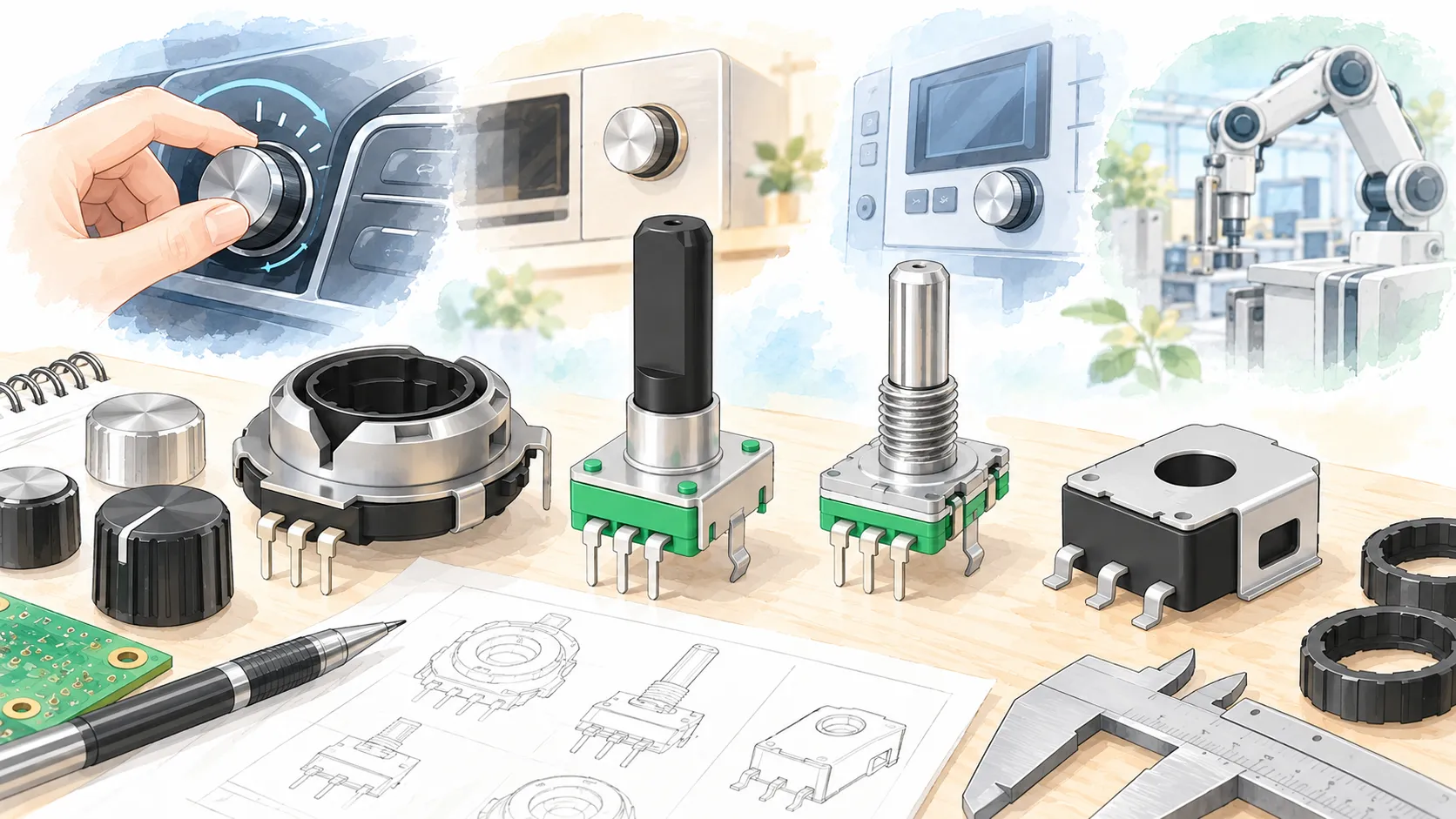
In Human-Machine Interface (HMI) control panels, automotive climate control knobs, medical equipment interfaces, and industrial servo motors, tactile feel, signal accuracy, and mechanical durability have become key priorities for hardware development teams. Whether adjusting the volume knob on an audio system or controlling the rotating joint of a robotic arm, the ability to accurately detect how many steps a knob has turned or how far a shaft has rotated depends on the precise operation of a rotary encoder.
With so many rotary encoder types available on the market, how should engineering and procurement teams evaluate their options? What critical mechanical design details are often overlooked during the selection process?
This comprehensive rotary encoder selection guide explores common encoder types, mechanical design considerations, and key selection factors, helping you make informed decisions for B2B sourcing and product development.
The Evolution of Encoder Technology: From Simple Pulse Counting to Multi-Turn Absolute Position Detection
To understand the development of incremental and absolute encoders, it is helpful to examine how control systems have evolved to meet increasingly demanding position sensing requirements:
。Incremental Pulse Counting Era (Widespread Adoption): Early automation control systems primarily relied on incremental encoders to generate continuous pulse signals, which were counted by downstream controllers such as PLCs or MCUs. Although these encoders featured simple structures and fast response times, accumulated position data could be lost when power was interrupted. Unless the controller retained the position information, the system typically required a homing procedure (Home Return) after restarting.
。Rise of Single-Turn Absolute Encoders (Precision Positioning): To overcome the limitations of position loss after power interruptions, absolute encoders were developed to provide a unique digital code for each angular position. Using encoded discs and coding methods such as Gray Code, these encoders allow the control system to immediately identify the shaft's current angular position upon startup, without requiring homing within a single revolution.
。Evolution of Multi-Turn Absolute Encoders and Enhanced Durability (Present Day): Modern multi-turn absolute encoders incorporate technologies such as internal gear mechanisms, battery-backed counting systems, or energy-harvesting solutions to track absolute positions across multiple revolutions. Meanwhile, incremental encoders continue to evolve through miniaturization, improved tactile feedback, and enhanced durability, making them widely used in consumer electronics and Human-Machine Interface (HMI) control panels.
What Is an Incremental Encoder? Understanding the Core Principles of Relative Displacement and Pulse Output
The core principle of an Incremental Encoder is to measure relative displacement. By counting the pulses generated as the shaft rotates, the control system can determine rotational displacement and speed.
The key operating mechanisms of an incremental encoder are as follows:
。A/B Channel Pulse Output: As the shaft rotates, an incremental encoder generates two square-wave pulse signals with a 90-degree phase difference, commonly referred to as Channel A and Channel B. The control system calculates the rotation angle based on the accumulated pulse count and determines whether the shaft is rotating clockwise or counterclockwise by analyzing the phase relationship between the two signals.
。Z Channel (Index / Zero Pulse) Reference Signal: Many industrial-grade incremental encoders also provide a third signal known as the Z Channel. For every complete shaft revolution (360 degrees), the Z Channel generates a narrow reference pulse. This signal serves as a reference point for position calibration, homing, or counting complete revolutions.
。Power-Loss Characteristics: Since incremental encoders do not store absolute position information, the control system may lose its accumulated position count when power is interrupted. After power is restored, the system typically needs to perform a homing procedure, moving the motor or shaft to a known reference position using the Z Channel or an external home sensor to re-establish the correct coordinate system. However, systems equipped with non-volatile position storage or backup power may retain position information without requiring a full homing cycle.
Incremental vs. Absolute Encoders: An In-Depth Comparison of Core Structures and Operating Principles
To understand the key differences between incremental and absolute encoders, the most straightforward approach is to compare their internal code disc structures and signal output methods:
。Code Disc Structure: Incremental encoders typically use code discs with evenly spaced optical slots or magnetic poles to generate pulses during rotation. In contrast, optical absolute encoders often feature multiple concentric code tracks, with each angular position represented by a unique binary or Gray Code pattern. This allows the encoder to identify the shaft's absolute angular position.
。Signal Transmission: Incremental encoders output pulse signals that the controller counts to determine relative movement. Absolute encoders, on the other hand, transmit digital position data, often through communication interfaces or protocols such as SSI, BiSS, CANopen, or Modbus, enabling the control system to read the shaft's absolute position directly.
Comprehensive Comparison Table: Incremental vs. Absolute Encoders
|
Comparison |
Incremental Encoder |
Absolute Encoder |
|---|---|---|
|
Operating Principle |
Counts continuous pulses and analyzes A/B phase differences to determine relative displacement |
Reads unique digital position codes, such as Gray Code, from the encoder disc |
|
Position Information |
Relative position; requires counting from a reference point |
Absolute position; each angular position has a unique digital value |
|
Behavior After Power Loss |
Position count may be lost, requiring homing after restart |
Absolute position can be read immediately after restart without homing |
|
Signal Output |
A, B, and optional Z channel square-wave pulse signals |
Digital position data through serial interfaces such as SSI, BiSS, or Modbus |
|
System Cost |
Generally lower, with simpler components and relatively inexpensive decoding |
Generally higher due to more complex position sensing and decoding circuitry |
|
Data Transmission & Noise Immunity |
Missed or false pulses caused by electrical noise may lead to accumulated position errors |
No cumulative pulse-counting errors; some communication protocols include data integrity checks |
|
Common Applications |
Home appliance and audio control knobs, automotive control panels, motor speed monitoring, conveyor systems |
Multi-axis robotic joints, high-precision CNC machines, medical automation equipment |
Recommended Reading:
Industry Applications of Incremental vs. Absolute Encoders: How to Choose the Right Encoder for Different Applications
After understanding the differences in their operating principles, how should manufacturers choose between incremental and absolute encoders for real-world product development?
Applications Best Suited for Incremental Encoders
1. Human-Machine Interfaces (HMIs) and Home Appliance Control Panels: Common examples include audio volume knobs, microwave timer controls, and automotive climate control panels. These applications primarily need to detect how many steps a knob turns clockwise or counterclockwise. Incremental encoders provide excellent tactile feedback with well-defined detents while offering a highly cost-effective solution.
2. Motor Speed and Continuous Motion Monitoring: In conveyor belts, fan motors, and general industrial pumps, the primary requirement is often to monitor rotational speed (RPM) rather than determine the shaft's exact angular position. Incremental encoders are an ideal choice for these applications.
3. Cost-Sensitive Systems with Homing Mechanisms: If equipment can perform a mechanical homing procedure during startup without affecting operational efficiency, selecting an incremental encoder can significantly reduce the overall Bill of Materials (BOM) cost.
Applications Best Suited for Absolute Encoders
1.Multi-Axis Robots and Robotic Arm Joints: If a robotic arm suddenly loses power during operation, unexpected movement during the homing process after restarting could cause collisions with surrounding equipment. Absolute encoders allow the control system to identify the current joint position immediately after power is restored, reducing the need for potentially hazardous homing movements.
2.High-Precision CNC Machine Tools and Semiconductor Equipment: These applications require highly accurate position feedback for cutting tools, motion axes, or wafer positioning stages. Absolute encoders provide reliable position information without relying solely on accumulated pulse counts, helping prevent positioning errors. In systems requiring micrometer-level precision, overall accuracy also depends on the encoder's resolution, mechanical design, and control system.
3.Safety-Critical Medical and Aerospace Equipment: Applications such as medical CT scanning tables and surgical robotic arms require accurate position information to support safe and reliable operation. Absolute encoders help eliminate the need for startup homing procedures and reduce periods when the system's position is unknown.
Favor Union: Integrating Next-Generation Precision Control Technology to Deliver High-Quality Encoders and Control Modules
Whether it is the smooth, well-defined rotational feel of an incremental encoder in a Human-Machine Interface (HMI) or precise pulse feedback in automated equipment, developing an encoder with distinct detents, balanced rotational resistance, and long-term signal stability requires extensive expertise in mechanical design, mold development, and electronic component assembly.
With over 40 years of experience in precision control components, Favor Union specializes in the research, development, and manufacturing of high-quality incremental encoders and electronic control components:
- Extensive Incremental Rotary Encoder Product Range: Offers a wide selection of rotary encoders and switch modules featuring excellent detent feel and accurate pulse signal output to meet various application requirements.
- Flexible Customization and Tactile Feel Optimization: With dedicated mechanical and electronic engineering teams, Favor Union provides customized solutions for rotational torque, mechanical dimensions, shaft materials, and Pulses Per Revolution (PPR) based on specific project requirements.
- International Quality Certifications: Favor Union's manufacturing facilities are certified to ISO 9001 and ISO 14001 standards, supporting consistent product quality, high reliability, and long-term performance stability.
- Made in Taiwan (MIT) Manufacturing Support: For demanding applications in medical devices, industrial equipment, and consumer electronics, Favor Union offers Made in Taiwan (MIT) manufacturing options to meet the sourcing and quality requirements of global supply chains.
Interested in next-generation incremental encoder technology or looking for a high-quality rotary encoder solution for your next project? Visit the Favor Union to submit your inquiry. Our professional technical and engineering teams are ready to provide encoder selection guidance, customized solutions, and sample evaluation support tailored to your application needs!