

What Is a Variable Resistor? A Complete Guide to Its Principle, Wiring, Specifications, and Measurement Methods

Many control functions in electronic devices that seem simple actually rely on variable resistors, such as knob adjustment, signal calibration, brightness control, and position feedback.For engineers, a variable resistor affects circuit stability and control accuracy. For purchasing teams, it is closely related to specification compatibility, product lifespan, supply stability, and future maintenance costs.
This article introduces the operating principle, types, applications, wiring methods, specifications, selection considerations, and measurement methods of variable resistors, helping companies make better decisions in circuit design, component selection, and supplier evaluation.
What Is a Variable Resistor? Understanding the Operating Principle and Basic Concepts
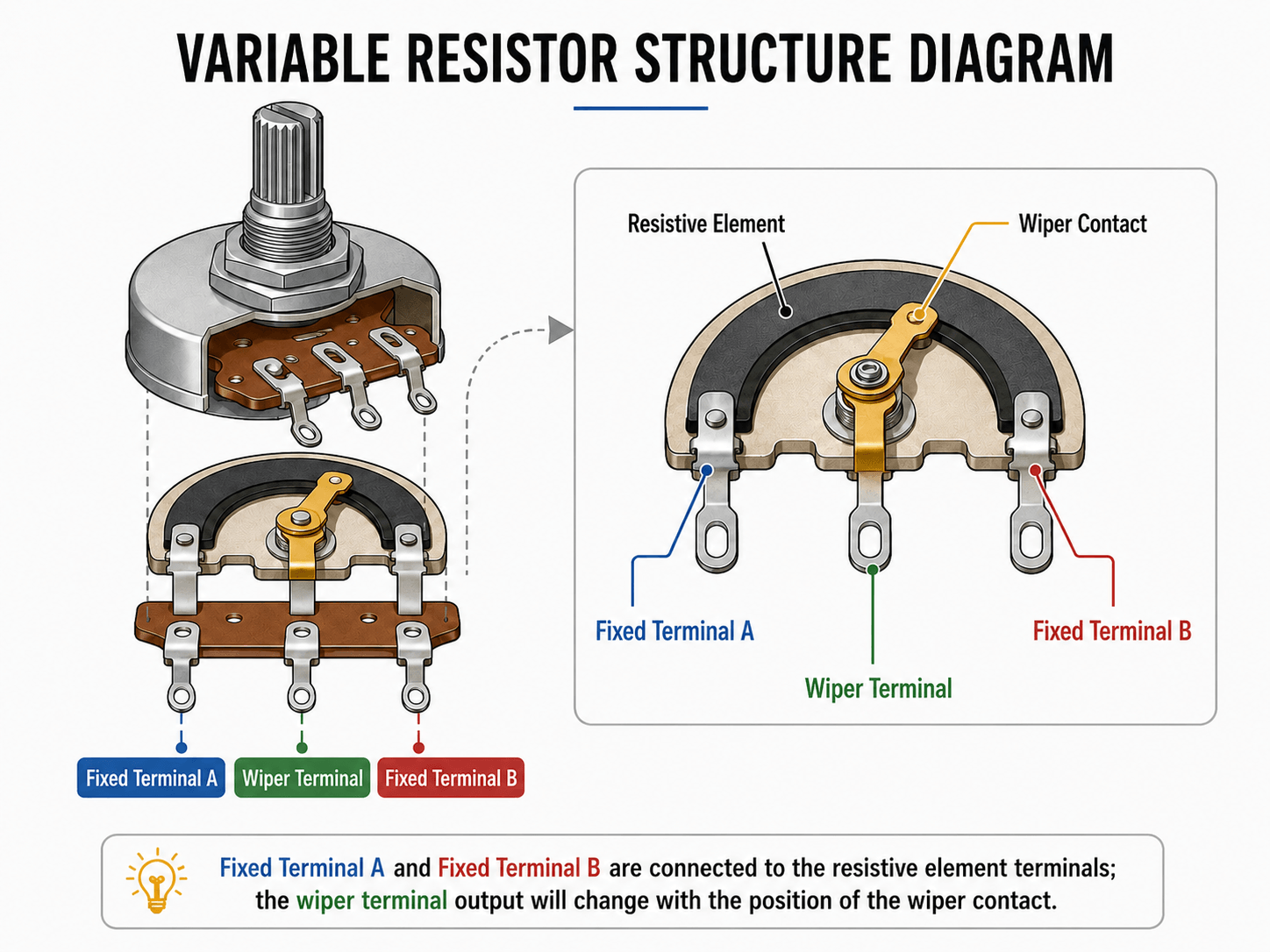
Structurally, a variable resistor typically consists of a fixed resistive element and a movable wiper contact. The resistive element is commonly made of carbon film, metal alloy, or conductive plastic. The movable contact, also called the wiper or brush, changes its position as the knob, slider, or adjustment screw is moved.
A standard variable resistor usually has three terminals, including two fixed terminals connected to both ends of the resistive track and one wiper terminal connected to the movable contact.Depending on the wiring method and application, a variable resistor may also be referred to as a potentiometer or a rheostat. The difference between the two lies mainly in how they are connected and used within a circuit.
Operating Principle of a Variable Resistor
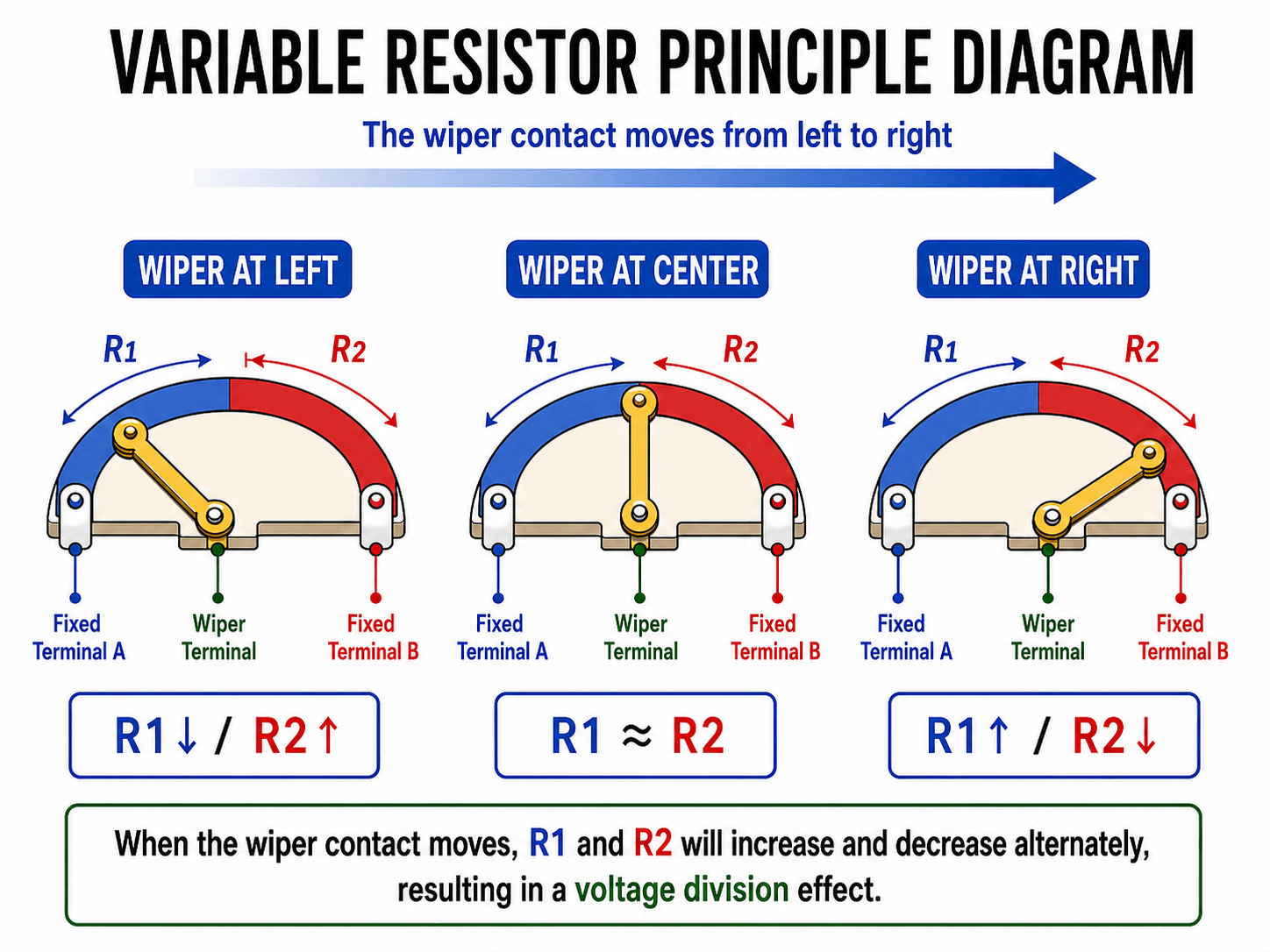
● Voltage Divider Principle (Used as a Potentiometer)When all three terminals are connected in a circuit, the variable resistor changes the resistance ratio between the upper and lower sections according to the position of the wiper. As a result, the output voltage changes continuously with the position of the wiper.This principle is commonly used for volume control or for providing analog position signals to microcontrollers.
● Variable Resistance Principle (Used as a Rheostat)When only two terminals are connected—one fixed terminal and the wiper terminal—the variable resistor no longer functions as a voltage divider. Instead, it directly changes the total resistance of the series circuit.By increasing or decreasing the resistance, the current flowing through the circuit can be limited or increased. This configuration is commonly used for motor speed control and light dimming.
Differences Between Fixed Resistors and Variable Resistors
|
Comparison Item |
Fixed Resistor |
Variable Resistor |
|
Resistance Characteristic |
The resistance value is fixed during manufacturing and cannot be changed. |
The resistance value can be adjusted smoothly and accurately within a specified range. |
|
Primary Application |
Used for current limiting, voltage division, bias setting, and circuit protection. |
Used for dynamic control, such as dimming, volume adjustment, and circuit calibration. |
|
Number of Terminals |
Usually has two terminals with no movable contact. |
Usually has three terminals, including two fixed terminals and one movable wiper terminal. |
|
Internal Structure & Lifespan |
Simple structure with no mechanical moving parts. Longer service life and less susceptible to physical wear. |
Contains a resistive track and a movable wiper. Frequent adjustment may result in mechanical wear or poor contact over time. |
|
Circuit Symbol |
Represented by a simple resistor symbol, indicating a fixed resistance value. |
Represented by a resistor symbol with an arrow indicating that the resistance is adjustable. |
Types of Variable Resistors: Four Common Structures
【Rotary Variable Resistor】
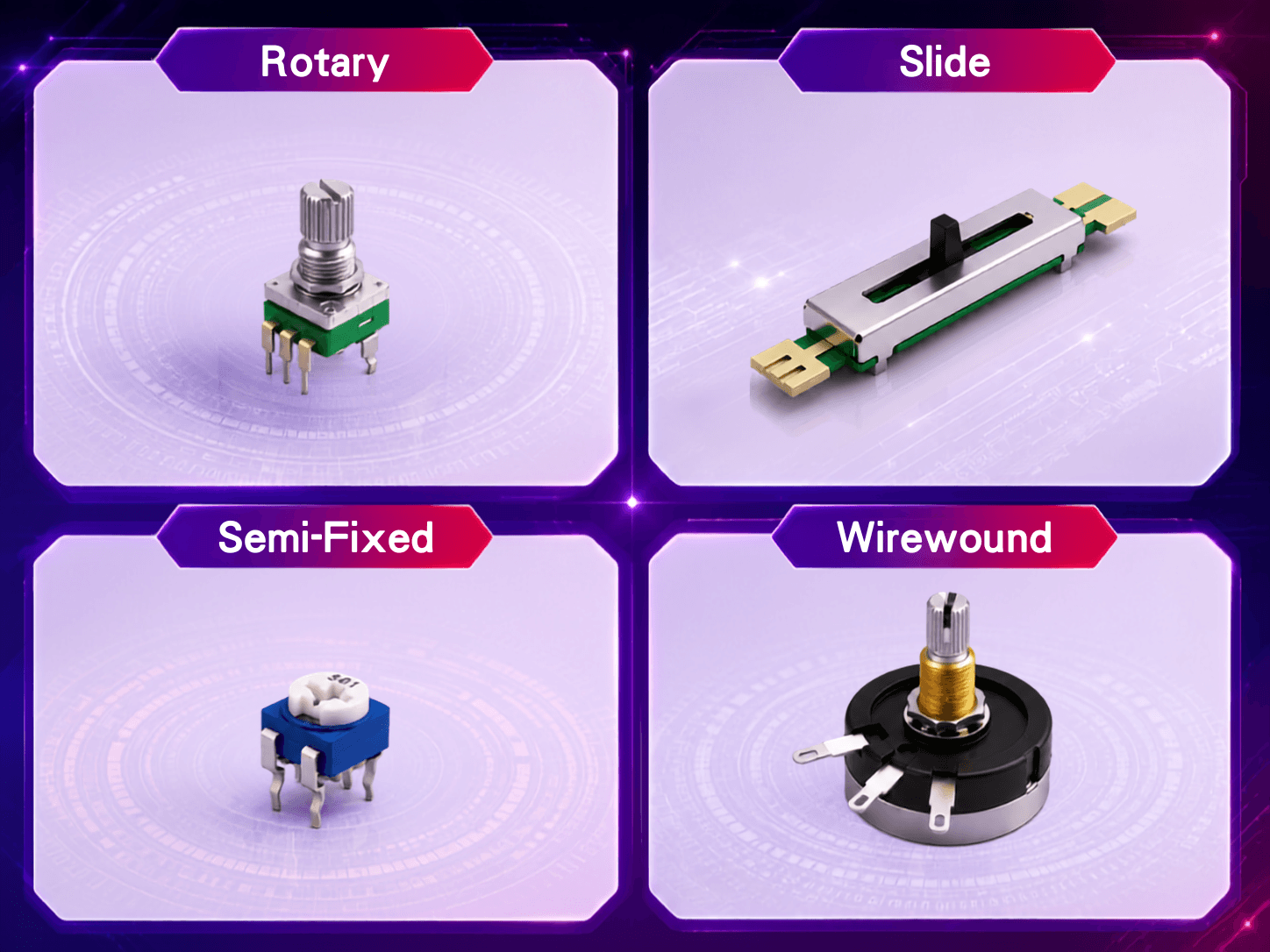
The rotary variable resistor is the most common type of variable resistor. It is typically operated by turning a knob or shaft. As the user rotates the shaft, the internal wiper moves along a circular resistive track, changing the resistance value or output voltage.
Rotary variable resistors can be divided into single-turn and multi-turn types according to their adjustment precision.Single-turn variable resistors have a limited rotation angle and are commonly used for audio volume controls, lighting dimmers, and simple motor speed control.Multi-turn variable resistors require multiple rotations to complete one full adjustment range, allowing much finer control. They are commonly used in circuits requiring precise calibration and adjustment.
【Slide Variable Resistor】
A slide variable resistor is also commonly referred to as a slider potentiometer or fader. Instead of rotational movement, its resistance is adjusted by moving a slider along a straight path.
As the slider moves, the internal wiper travels across a linear resistive track, causing the resistance value to change according to its position.One of the main advantages of this type is its intuitive operation. Users can easily determine the current setting simply by observing the slider position.Slide variable resistors are widely used in audio mixers, lighting control consoles, and multi-channel control equipment, making them suitable for applications requiring quick adjustments, simultaneous control, or smooth fade-in and fade-out operations.
【Trimmer Variable Resistor】
A trimmer variable resistor, often referred to simply as a trimmer or trimmer potentiometer, is primarily mounted on a printed circuit board (PCB) and is intended for circuit adjustment during assembly, testing, or factory calibration rather than frequent user operation.
These components are generally compact in size and do not feature an external adjustment knob. Instead, they are usually adjusted using a small screwdriver.Typical applications include fine adjustment of reference voltage, bias settings, frequency calibration, and sensor output calibration.Once the desired setting has been completed, the trimmer is normally left in a fixed position to prevent accidental adjustment during normal operation, ensuring stable circuit performance.
【Wirewound Variable Resistor】
A wirewound variable resistor is classified according to its internal resistive material and construction.It is typically manufactured by winding resistance wire—such as nichrome or constantan wire—around a ceramic or insulated core. The resistance value is adjusted by changing the contact position of the movable wiper along the resistance wire.
Wirewound variable resistors offer excellent heat resistance and can withstand relatively high power levels, making them suitable for high-current or heavy-load applications such as industrial equipment, heating control, and motor speed control.However, because of their coil structure, they may introduce inductance, making them less suitable for high-frequency circuits. In addition, their adjustment may not be as smooth as carbon-film or conductive-plastic variable resistors.
Applications of Variable Resistors: Six Common Electronic Applications
By adjusting the resistance value, a variable resistor can control current, voltage, or output signals within a circuit. As a result, it is widely used in equipment requiring manual control, signal adjustment, and parameter calibration.The following are six of the most common applications of variable resistors in electronic devices.
Audio and Volume Control
Volume control is one of the most common applications of variable resistors.Radios, amplifiers, speakers, and various audio systems commonly use variable resistors to adjust the amplitude of audio signals, allowing users to control the output volume by rotating a knob.
In audio applications, logarithmic taper potentiometers are commonly used because their output characteristics better match the way the human ear perceives changes in sound volume.The Audio Engineering Society (AES)also provides technical references regarding the use of logarithmic tapers in audio circuit design.Besides volume adjustment, variable resistors can also be used for left-right channel balance control.
Lighting and Display Brightness Control
Variable resistors are also commonly used for adjusting the brightness of lighting systems and display panels.As the resistance changes, the voltage or current within the circuit changes accordingly, allowing the brightness of lamps, LEDs, or display backlights to be adjusted.
Typical applications include dimmer switches, automotive dashboard brightness adjustment, and the brightness control of early computer monitors and electronic devices.These applications generally require smooth and continuous adjustment to prevent sudden changes in brightness.
Motor Speed Control and Heating Control
When a variable resistor is used as a rheostat, it is connected in series within a circuit to directly change the total circuit resistance.As the resistance increases, the current flowing through the load decreases. Conversely, when the resistance decreases, the current increases. This characteristic makes variable resistors suitable for controlling motor speed or heating power.
Common applications include:
● Small DC motor speed control
● Fan speed adjustment
● Heating element power regulation
● Basic electric heating equipment
However, circuits of this type usually generate a considerable amount of heat. Therefore, when selecting a variable resistor, engineers should carefully evaluate its power rating and heat resistance to prevent overheating or component failure.
Position and Angle Sensors
A variable resistor can also convert mechanical movement into an analog voltage signal, making it suitable for use as a position or angle sensor.As the rotational angle or sliding position changes, the output voltage at the wiper changes accordingly, allowing the control system to determine the current position.
Typical applications include:
● Game controllers
● Remote controls
● Accelerator pedals
● Steering angle sensors
● Industrial robotic arms
● Position feedback systems
The main advantages of this application are its simple structure and easy-to-read analog signal, making it suitable for systems requiring rotational or linear position detection.
Circuit Calibration and Fine Adjustment
During circuit assembly, testing, and maintenance, engineers often use trimmer potentiometers for calibration.These variable resistors are generally compact and soldered directly onto the PCB. They are not intended for frequent adjustment by end users.
Typical calibration items include:
● Reference voltage
● Amplifier gain
● Sensor output
● Bias voltage
● Oscillation frequency
After calibration is completed, the trimmer usually remains fixed in position to maintain stable circuit performance throughout the product's operating life.
Microcontroller and Interactive Control
Variable resistors are widely used in Arduino, Webduino, and other microcontroller projects to provide analog input signals.Using a voltage divider configuration, the wiper terminal of the variable resistor is connected to the analog input pin of the microcontroller, allowing the system to read the position of the adjustment knob.
Common beginner projects include:
● Adjusting LED brightness
● Controlling servo motor angle
● Changing values displayed on a screen
● Creating simple human-machine interface (HMI) controls
Because they are intuitive to operate and easy to wire, variable resistors are commonly used in electronics education to help beginners understand analog signals and voltage divider circuits.
How to Wire a Variable Resistor: Voltage Divider Configuration
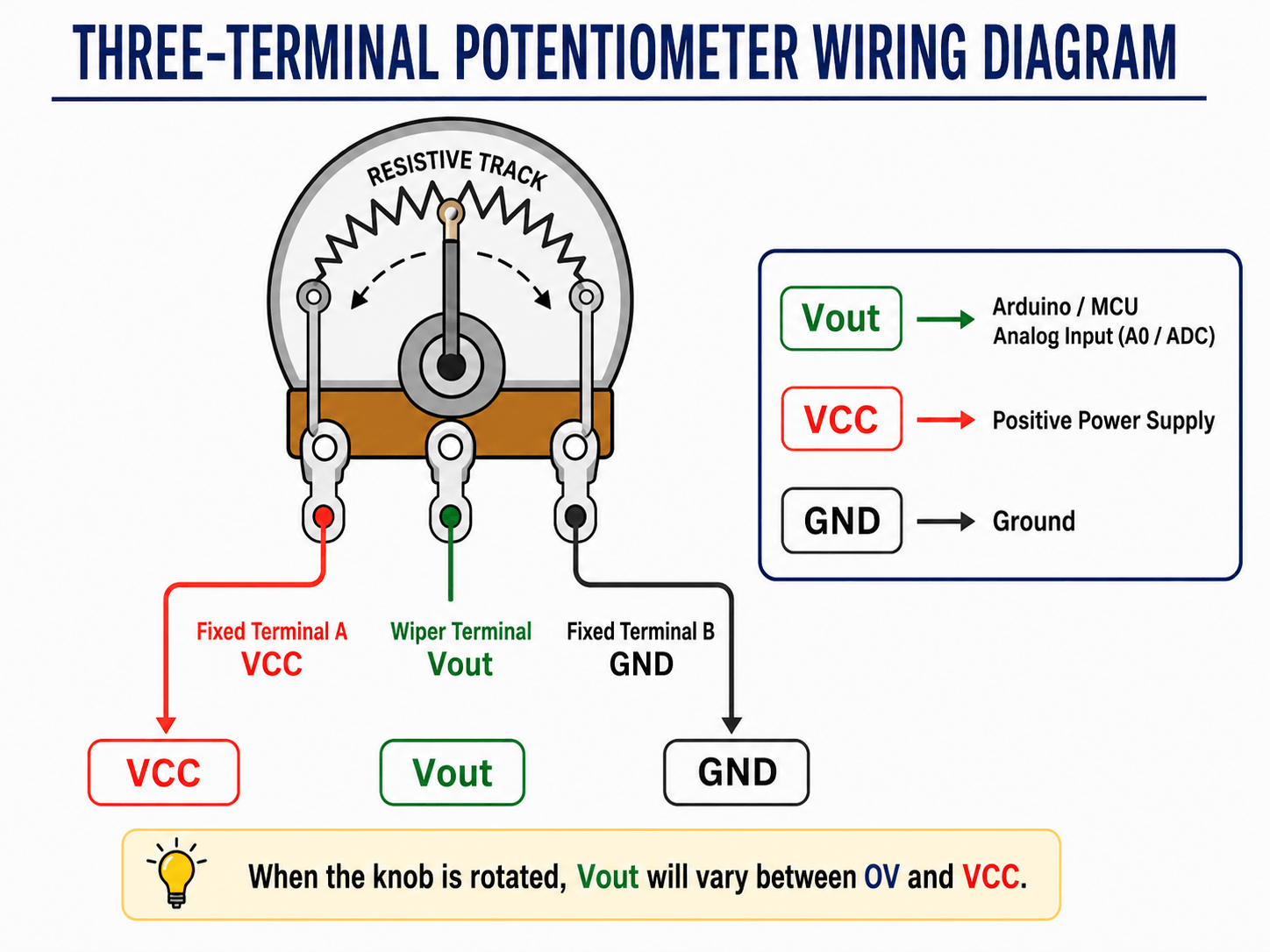
The most common wiring method for a variable resistor is the three-terminal voltage divider configuration.The two fixed terminals are connected to VCC and GND, while the center wiper terminal serves as the output voltage (Vout).As the knob or slider is moved, Vout changes continuously according to the position of the wiper.The wiring configuration is shown below.
|
Terminal |
Connection |
Function |
|
Left Fixed Terminal |
Connect to VCC (such as 5 V or 3.3 V) |
Input Voltage |
|
Right Fixed Terminal |
Connect to GND |
Ground |
|
Center Wiper Terminal |
Connect to the signal input pin (such as Arduino A0) |
Outputs a variable analog voltage |
The order of connecting the two fixed terminals to VCC and GND may be reversed without causing a short circuit.The only difference is the direction of the output.For example, if the output value originally increases when the knob is turned clockwise, reversing the two fixed terminals will cause the output value to decrease when turned clockwise.If the measured direction is opposite to the intended operation, simply swap the wiring of the two fixed terminals.
When the three-terminal voltage divider configuration is used, the variable resistor can be regarded as two resistors connected in series, with the center wiper acting as the output node.
As the knob or slider moves, the ratio between the upper and lower resistance changes, causing the output voltage to change continuously.Let:Vin = Input Voltage
Vout = Output Voltage
R1 = Resistance between Vin and the Wiper
R2 = Resistance between the Wiper and GND
The voltage divider equation is:Vout = Vin × R2 / (R1 + R2)
Because the total resistance of the variable resistor remains approximately constant, moving the knob mainly changes the ratio between R1 and R2.As a result, Vout changes continuously between 0 V and the input voltage.For example, with a 5 V input supply, the output voltage at the wiper varies continuously from approximately 0 V to 5 V depending on the knob position.
After the microcontroller reads this analog voltage, it can convert the knob position into digital data for applications such as:
● LED brightness control
● Servo motor positioning
● Display value adjustment
● Interactive electronic controls
How to Read Variable Resistor Specifications: 9 Key Selection Considerations
Basic information such as the resistance code, part number, or model designation is usually marked on the body of a variable resistor for quick identification.However, complete specifications—including power rating, tolerance, resistive material, operating life, and mounting dimensions—should always be verified using the product datasheet or information provided by the supplier.When selecting a variable resistor, it is recommended to first confirm that the nominal resistance value and power rating satisfy the circuit requirements, and then compare the electrical specifications, physical dimensions, and mechanical construction to reduce the risk of specification mismatch or installation issues.
(1) Electrical Specifications
Resistance Range
The resistance range specifies the minimum and maximum resistance values that a variable resistor can provide.Common units include Ω (ohms), kΩ (kilohms), and MΩ (megohms).Different applications require different resistance values depending on whether the component is used for voltage division, signal adjustment, or current limiting.
If the resistance is too low, excessive current may flow through the circuit.If the resistance is too high, the signal variation may become insignificant and could even affect the circuit's response.Therefore, the appropriate resistance range should always be selected according to the electrical requirements of the application.
Tolerance
Tolerance refers to the allowable deviation between the actual resistance value and the nominal resistance value.A smaller tolerance indicates that the actual resistance is closer to the specified value, resulting in higher accuracy.
Typical variable resistors have tolerances ranging from ±5% to ±20%.For general applications such as volume or brightness control, a relatively wide tolerance is usually acceptable.For calibration circuits, sensing applications, or precision control systems, components with tighter tolerance should be selected.
Power Rating
The power rating indicates the maximum amount of power that a variable resistor can safely dissipate during continuous operation.If the actual power exceeds the rated specification, the component may overheat, burn out, or experience unstable resistance characteristics.
Low-power variable resistors are generally sufficient for signal control circuits.However, applications such as motor speed control, heating systems, or high-current loads require variable resistors with higher power ratings.
Maximum Voltage
The maximum voltage specifies the highest operating voltage that the variable resistor can safely withstand.Applying a voltage beyond this limit may damage the internal insulation, resulting in dielectric breakdown or electrical discharge.
In low-voltage control circuits, exceeding the maximum voltage is generally not a concern.However, for industrial equipment, power control systems, or other high-voltage applications, the maximum voltage rating should always be verified.
Temperature Coefficient
The temperature coefficient indicates how much the resistance value changes as the ambient temperature changes.It is typically expressed in ppm/°C (parts per million per degree Celsius).A lower temperature coefficient means that the resistance remains more stable over varying temperatures.
If the variable resistor is intended for high-temperature environments or applications requiring highly stable electrical performance, the temperature coefficient should be carefully considered.For ordinary manual control applications, it may not be the primary selection criterion, but it can still influence long-term operating stability.
(2) Physical and Mechanical Specifications
Resistive Material
The resistive material directly affects the durability, power handling capability, adjustment smoothness, and long-term stability of a variable resistor.
Common resistive materials include:
● Carbon Film
● Wirewound
● Cermet
Carbon-film variable resistors are commonly used in general consumer electronics and audio volume control applications.Wirewound types provide higher power handling capability and are suitable for high-current or heating-control applications.Cermet types are widely used in circuits requiring excellent stability, reliability, and durability.
Adjustment Type
The adjustment type determines the operating method, installation requirements, and intended application.
When selecting a variable resistor, engineers should determine whether the product requires:
● An exposed rotary knob
● A linear slider
● A PCB-mounted trimmer for circuit calibration
Choosing the appropriate adjustment type helps ensure compatibility between the electrical component and the overall mechanical design.
Durability / Life Cycle
Durability represents the number of operating cycles that a variable resistor can withstand before mechanical wear or poor electrical contact begins to affect its performance.Since a variable resistor contains a movable wiper, long-term operation may eventually result in contact degradation, electrical noise, or unstable resistance.
For components adjusted only during factory calibration, operating life is generally less critical.However, for applications such as:
● Game controllers
● Joysticks
● Rotary knobs
● Industrial control panels
products with a higher operating life should be selected to ensure long-term reliability.
Mounting Style
The mounting style determines how securely the variable resistor can be installed on a printed circuit board or equipment enclosure.
Common mounting methods include:
● Through-hole PCB mounting
● Panel mounting
● Surface-mount technology (SMT / SMD)
PCB-mounted types are suitable for direct soldering onto circuit boards.Panel-mounted types are commonly used in equipment requiring external knobs for user operation.Surface-mount devices (SMD) are ideal for compact electronic products.If the variable resistor will be operated frequently by turning or sliding, engineers should evaluate not only the mounting method but also the mechanical strength of the installation to prevent loosening during long-term use.
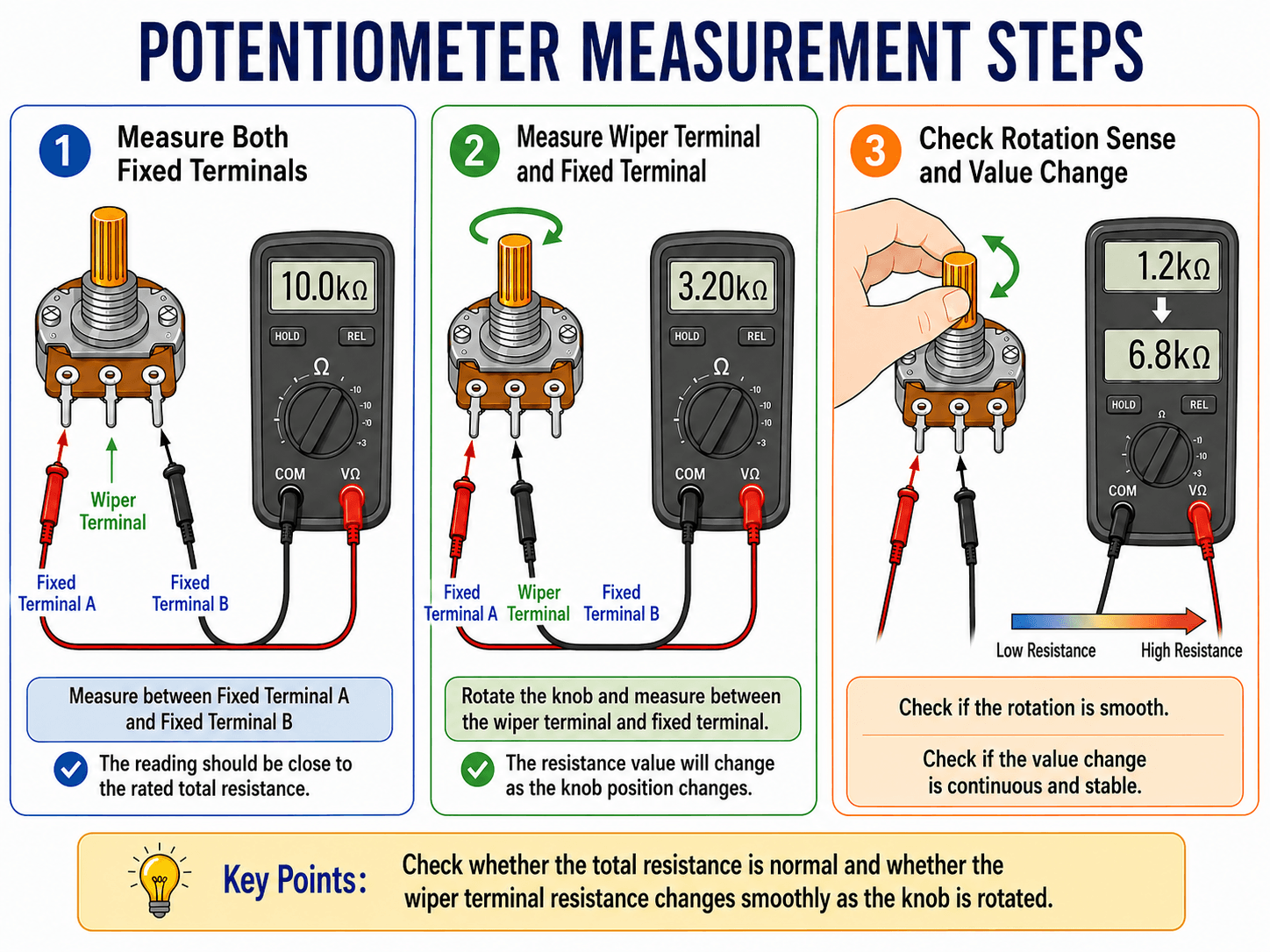
How to Measure a Variable Resistor
After prolonged use, a variable resistor may develop unstable resistance, poor electrical contact, or even complete failure due to wiper wear, dust accumulation, moisture, oxidation, or electrical overload.To determine whether the component is functioning properly, engineers should measure both the total resistance between the two fixed terminals and the resistance variation between the wiper and the fixed terminal, confirming that the measured values correspond to the specified resistance and change smoothly throughout the adjustment range.
Before taking any measurements, ensure that the circuit power is completely disconnected.To minimize measurement errors caused by other parallel components, it is recommended to remove the variable resistor from the PCB before testing.Set the digital multimeter to the Resistance (Ω) mode, connect the black probe to the COM terminal and the red probe to the VΩ terminal, then select the appropriate measurement range according to the rated resistance of the component.The inspection can be performed using the following three steps.
Step 1: Measure the Total Resistance Between the Two Fixed Terminals
Place the multimeter probes on the two fixed terminals (Terminal 1 and Terminal 3).The measured resistance should be close to the maximum resistance value printed on the component and remain within the specified tolerance.
For example, a variable resistor marked 103 indicates a nominal resistance of approximately 10 kΩ.If the measured value falls within the acceptable tolerance range, the resistive track is generally considered to be functioning normally.If the multimeter displays OL, infinite resistance, or a value significantly higher than the rated resistance, the internal resistive track may be broken, burned, or severely deteriorated, and the component should be replaced.
Step 2: Measure the Resistance Between the Wiper and a Fixed Terminal
Next, connect one probe to the center wiper terminal (Terminal 2) and the other probe to either fixed terminal.Slowly rotate the knob or move the slider while observing the resistance displayed on the multimeter.
Under normal operating conditions, the resistance should change smoothly from approximately 0 Ω to the rated maximum resistance, or vice versa depending on the terminal connection.If the measured value fluctuates significantly, changes erratically, or occasionally displays OL, the wiper may have poor contact with the resistive track due to wear, dust accumulation, or oxidation.You may also measure the resistance between Terminal 1 and Terminal 2, and between Terminal 2 and Terminal 3, while keeping the knob in the same position.The sum of these two measured values should approximately equal the total resistance measured between Terminal 1 and Terminal 3.
Step 3: Check the Mechanical Feel and Listen for Abnormal Noise
Besides measuring electrical values, the mechanical feel of the variable resistor can also indicate its condition.A properly functioning variable resistor should rotate or slide smoothly without sticking, excessive looseness, or inconsistent resistance.
If scratching sounds, rough movement, excessive friction, or unstable operation occurs at certain positions, the internal mechanism may have experienced wear, dust contamination, insufficient lubrication, or shaft misalignment.Even if the measured resistance appears normal, these conditions may introduce electrical noise, intermittent signals, or unstable control during actual operation.Replacement should be considered based on the application's reliability requirements.
Frequently Asked Questions (FAQ)
Q: What Is the Typical Lifespan of a Variable Resistor?
The service life of a variable resistor depends on its construction, resistive material, electrical load, operating environment, and frequency of use.When selecting a product, engineers should evaluate not only the resistance value and physical dimensions but also the operating life specified in the product datasheet.
For applications such as industrial automation, gaming controllers, UAV controllers, and medical equipment that require frequent operation, products with higher durability and longer operating life are recommended.FAVOR UNION offers a wide range of variable resistors and control components, with selected high-durability models providing an operating life of up to 5 million cycles for long-term, high-reliability applications.
Q: What Is the Basic Unit of Resistance?
The basic unit of electrical resistance is the ohm (Ω).
For larger resistance values, kilohms (kΩ) and megohms (MΩ) are commonly used.
● 1 kΩ = 1,000 Ω
● 1 MΩ = 1,000,000 Ω
Commercially available variable resistors generally provide resistance values ranging from approximately 100 Ω to 10 MΩ.The appropriate resistance should be selected according to the circuit application, voltage and current requirements, and control objectives.
Q: Can Variable Resistors Be Customized?
Yes.Customization depends on the design and manufacturing capabilities of the supplier.
Common customization options include:
● Resistance range
● Rotation angle
● Shaft length
● Operating torque
● Resistance tolerance
● Mounting method
● Housing structure
Since custom products may require tooling, prototype production, and testing, they generally involve minimum order quantities (MOQ), development costs, and longer lead times.If a product is entering mass production, specifications, delivery schedules, and long-term supply capability should be confirmed during the early development stage.
Q: Why Should the Country of Origin Be Confirmed When Purchasing Variable Resistors?
Certain industries have strict supply chain requirements.Products used in defense, medical, automotive, or exports to the United States may require components manufactured outside specific regions.Purchasers should confirm whether the supplier can provide products manufactured in Taiwan, non-China certificates of origin, or flexible multi-country manufacturing solutions.
For corporate procurement, the country of origin affects not only regulatory compliance but also lead time stability, supply chain risk, and customer qualification requirements.
Q: Are Variable Resistors Suitable for Long-Term Supply Programs?
Yes.However, long-term availability should be confirmed before product adoption.Industrial automation equipment, medical devices, and professional audio products often have long product life cycles.If a variable resistor is frequently discontinued or becomes obsolete, it may affect future production, maintenance, and replacement.
Purchasers are advised to verify product life cycle information, alternative part availability, batch consistency, and delivery stability.For large-volume procurement, requesting engineering samples and production batch information is also recommended to ensure consistent resistance characteristics, operating feel, and product quality.
Q: What Quality Certifications Should Be Considered When Selecting a Variable Resistor?
The required certifications depend on the target application.
Common quality management certifications include:
● ISO 9001
● ISO 14001
For automotive applications, suppliers may also be required to comply with IATF 16949.
Besides certifications, practical industry experience is equally important.Suppliers with proven experience in UAVs, gaming equipment, industrial automation, medical devices, or professional audio products can provide greater confidence during supplier evaluation.

Choosing a Reliable Variable Resistor Supplier:FAVOR UNION
Diverse Manufacturing Locations
● Global Manufacturing Network: FAVOR UNION operates manufacturing facilities in Taiwan, China, and Vietnam, with service offices located in Japan and Hong Kong.
● Convenient International Logistics: Our distributed manufacturing network provides a variety of shipping solutions, offering the flexibility to support customers' international shipping and receiving requirements.
Extensive Customization Capability
● Customized Specifications: Precision customization is available for rotation angle, resistance tolerance, special mechanical structures, operating feel, and extended operating life of up to millions of cycles.
● Seamless Replacement for Discontinued Parts: With strong reverse engineering and tooling capabilities, FAVOR UNION can accurately replicate the original specifications when the original supplier discontinues a product, allowing customers to seamlessly replace the component without modifying their circuit design or mechanical structure.
Vertically Integrated Manufacturing
● 97% In-House Manufacturing: From raw material processing to finished products, including the large-scale automated production equipment used in our factories, everything is designed and manufactured in-house by the FAVOR UNION Group.
● Strong Risk Management Capability: Through deep vertical integration, FAVOR UNION maintains precise control over product quality, lead time, and pricing, reducing the impact of material shortages and disruptions in the external supply chain.
Flexible Production and Delivery
● Flexible Support for Development and Mass Production: FAVOR UNION provides flexible development support and mass production services based on customers' requirements for lead time, customized MOQs, and technical communication, helping products enter the supply chain smoothly.
● Supporting Every Stage from Product Validation to Mass Production: Whether it is low-volume sample development during the early product validation stages (EVT/DVT) or high-volume production in the later manufacturing stage, FAVOR UNION provides stable lead time arrangements throughout the product development process.
Certified Quality Management System
● International Automotive-Grade Certifications: FAVOR UNION is certified to ISO 9001 (Quality Management), ISO 14001 (Environmental Management), and IATF 16949 (Automotive Quality Management), a globally recognized certification with rigorous requirements for entering the automotive supply chain.
● Trusted by Global Industry Leaders: Our products are used in applications including UAVs, gaming equipment, VR headsets, and professional audio devices, providing customers with a strong reference when evaluating supplier capabilities.
Looking for customized variable resistors with stable long-term supply?FAVOR UNION provides specification evaluation, custom development, and production support to help businesses establish reliable variable resistor supply solutions.
Contact us today to learn more about our customization capabilities and partnership opportunities.