

Pressure Sensor Types and Applications: 4 Key Types Explained
In industrial automation, smart healthcare, automotive systems, and consumer electronics, accuracy, environmental adaptability, and ease of integration have become key priorities for hardware development teams. With so many sensing components available on the market, engineers and procurement professionals often ask: What are the different types of pressure sensors, and which applications are best suited for each technology?
In fact, there is no one-size-fits-all pressure sensor. Different operating mechanisms, such as changes in electrical resistance, capacitance, or electric charge, determine how sensors perform when measuring gas pressure, liquid pressure, or surface contact forces.
This article explores the four major types of pressure sensors, their key characteristics, differences, and industrial applications, helping you make informed sensor selection decisions based on your product requirements.
Pressure Sensor Types and Applications: 4 Key Types Explained
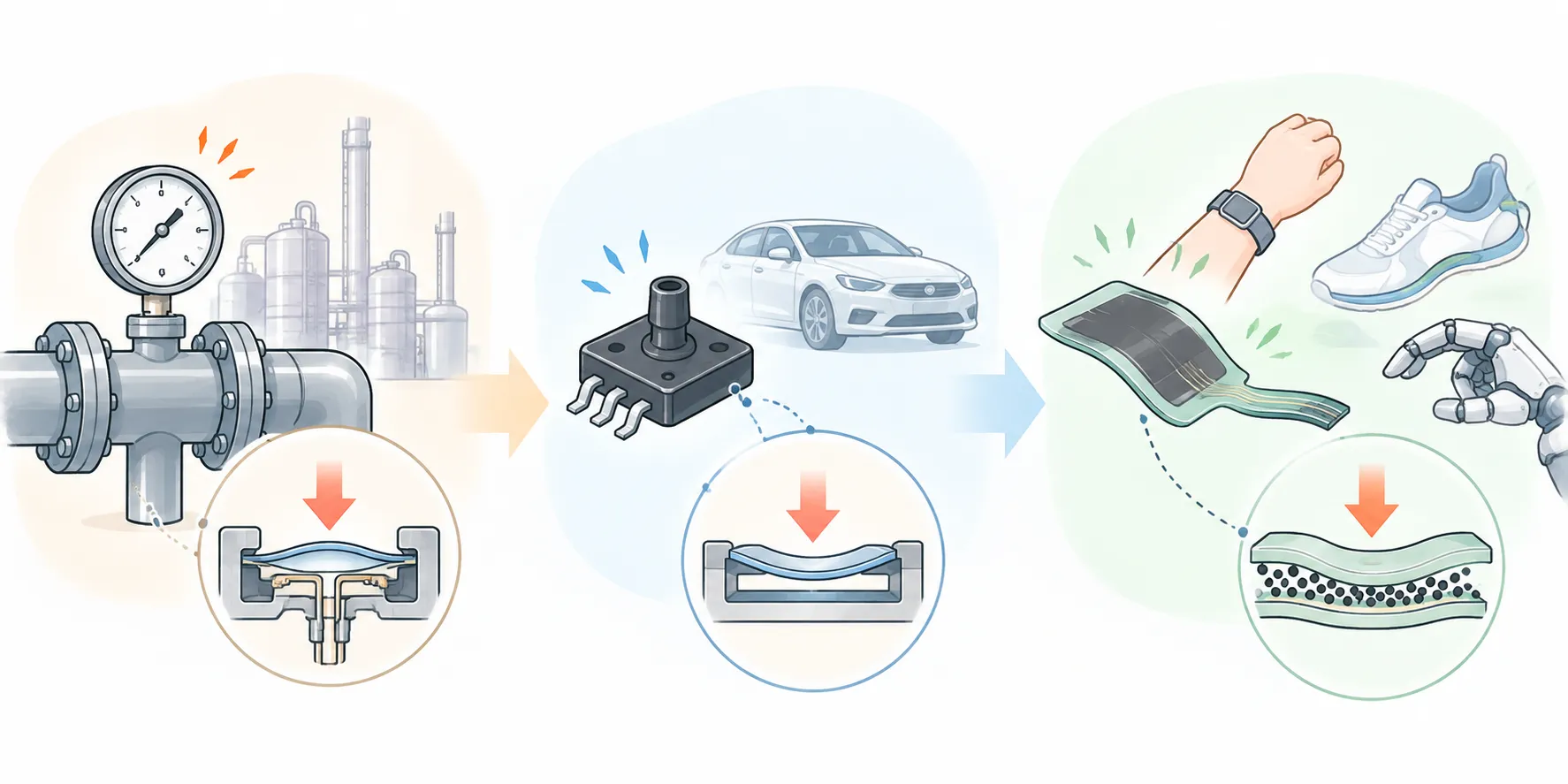
To understand the evolution of pressure sensor types, it is helpful to examine how industrial application requirements have expanded over time:
\- Traditional Industrial Gas and Hydraulic Pressure Monitoring: Early pressure measurement technologies primarily focused on pipelines, air compressors, and hydraulic systems, where high-pressure resistance and measurement accuracy were essential. These requirements drove the development of metal strain gauges and early piezoresistive sensing elements.
\- MEMS Miniaturization and Expansion into Automotive Applications: With advancements in Micro-Electro-Mechanical Systems (MEMS) technology, pressure sensors became significantly smaller, enabling widespread adoption in automotive Tire Pressure Monitoring Systems (TPMS), HVAC systems, and medical equipment.
\- Flexible Tactile Sensing and Smart Human-Machine Interfaces (Present Day): In recent years, growing demand for thin, lightweight, and flexible sensing solutions in wearable devices, smart medical mattresses, and robotic tactile systems has accelerated the adoption of FSR thin-film pressure sensors. These sensors address the limitations of traditional rigid sensors, particularly in applications involving curved surfaces and extremely compact spaces.
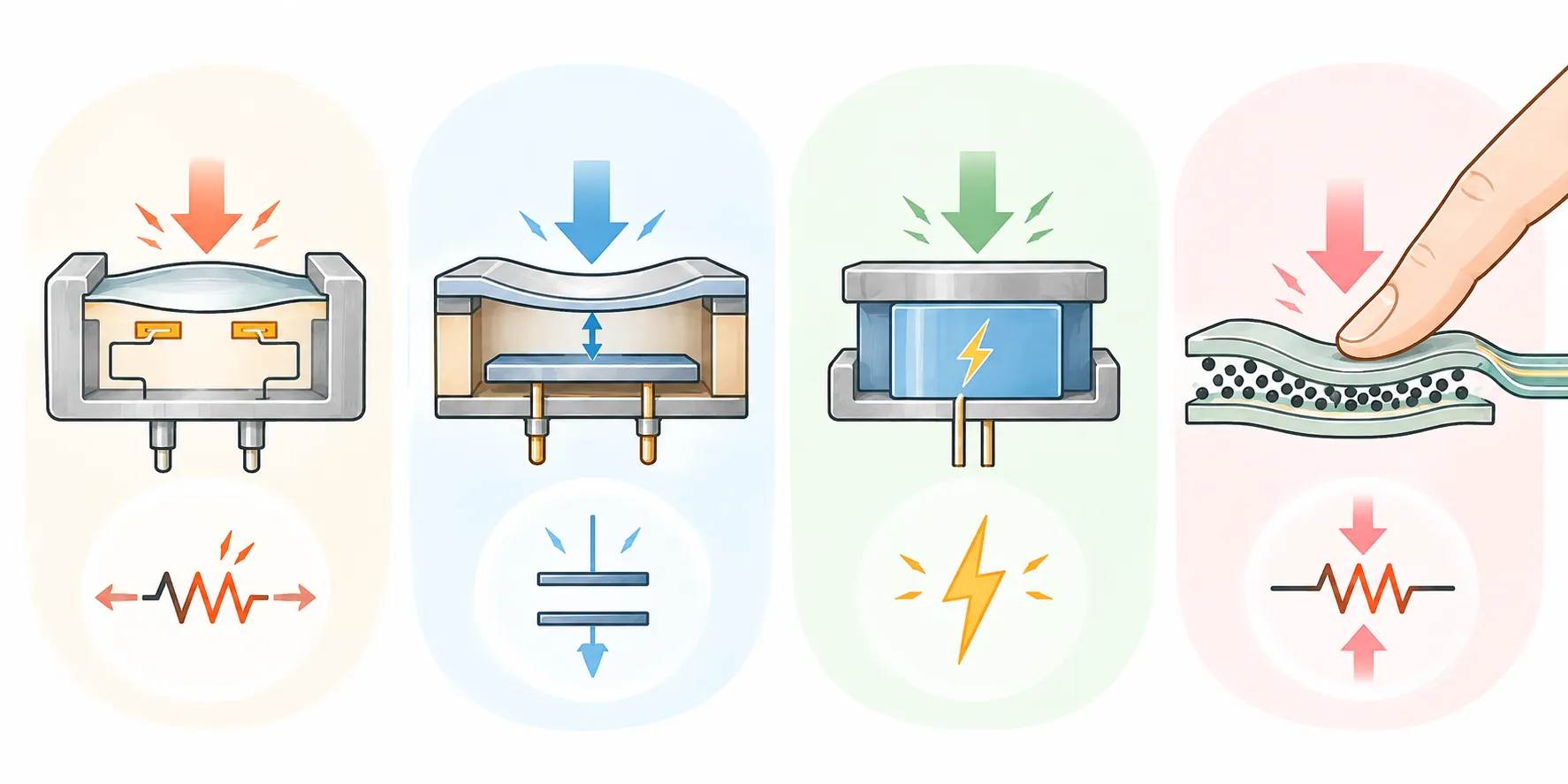
4 Major Types of Pressure Sensors: Operating Principles and Key Features
Based on their sensing principles and structural designs, the most common pressure sensors on the market can be divided into four major types:
1. Piezoresistive Pressure Sensors
-
Operating Principle: Piezoresistive pressure sensors utilize changes in the electrical resistance of semiconductor or metal-based sensing elements when subjected to mechanical stress. When gas or liquid pressure deforms the sensing diaphragm, the resulting stress causes the resistance of the sensing elements to change.
-
Key Advantages: Highly mature technology, excellent stability, and reliable response to both static and dynamic pressure. Piezoresistive sensors are among the most widely used pressure sensing technologies in industrial applications.
2. Capacitive Pressure Sensors
-
Operating Principle: Capacitive pressure sensors typically contain two closely positioned electrodes. When external pressure causes the sensing diaphragm to move slightly, the distance between the electrodes changes, resulting in a corresponding change in capacitance.
-
Key Advantages: High sensitivity, low power consumption, and potentially good temperature stability with appropriate design and compensation. These sensors are particularly suitable for measuring small pressure differences.
3. Piezoelectric Pressure Sensors
-
Operating Principle: Piezoelectric pressure sensors use crystalline or other piezoelectric materials that generate electrical charges when subjected to mechanical forces such as impact, compression, or vibration.
-
Key Advantages: Extremely fast response times, potentially reaching the microsecond range, making them ideal for detecting rapidly changing dynamic forces and impacts. However, they are generally unsuitable for long-term static pressure measurement.
4. FSR Thin-Film Pressure Sensors (Force Sensing Resistors)
-
Operating Principle: FSR sensors use flexible polymer films and pressure-sensitive conductive coatings. When no force is applied, the sensor maintains high electrical resistance. As external force increases, the conductive contact area increases, causing electrical resistance to decrease.
-
Key Advantages: Ultra-thin construction (typically less than 0.5 mm), flexibility, and customizable shapes and sizes. FSR sensors are particularly suitable for detecting contact and relative force levels on human bodies or object surfaces.
Key Differences Between Pressure Sensor Types: How to Choose the Right Technology
When selecting the right pressure sensor technology, the key is to evaluate the measurement target and installation environment.
Comprehensive Comparison Table of Pressure Sensor Types
|
Pressure Sensor Type |
Piezoresistive |
Capacitive |
Piezoelectric |
FSR Thin-Film Sensors |
|---|---|---|---|---|
|
Primary Measurement Targets |
Gases and liquids |
Gases and small pressure differences |
Dynamic impact forces |
Forces applied to human or object surfaces |
|
Force / Pressure Conditions |
Static and general dynamic pressure |
Small pressure changes and differential pressure |
High-frequency impacts and vibrations |
Contact force, pressing, and relative force |
|
Key Advantages |
Mature technology, wide measurement range |
High sensitivity, low power consumption |
Extremely fast dynamic response |
Ultra-thin, flexible, and highly customizable |
|
Main Limitations |
Relatively sensitive to temperature drift |
Requires careful circuit design to minimize interference |
Unsuitable for static pressure measurement |
Unsuitable for high-precision absolute force or weight measurement |
|
Common Applications |
Industrial pipelines, automotive tire pressure monitoring |
Medical devices, HVAC systems |
Impact testing, mechanical vibration monitoring |
Smart insoles, seats, wearable devices |
推薦閱讀:
Industrial Applications of Pressure Sensors: Which High-Performance Products Are Driving Adoption?
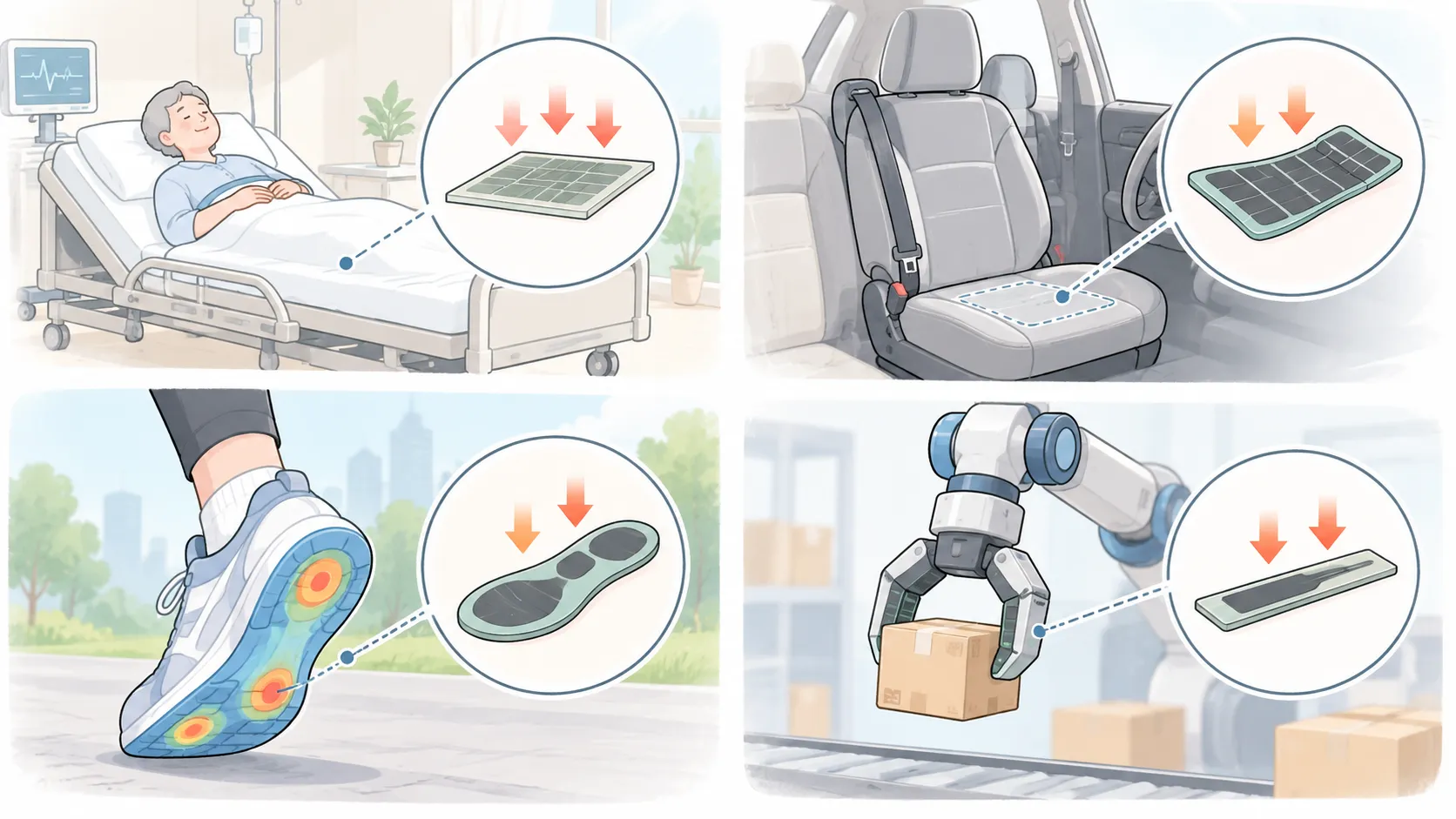
Understanding the different types of pressure sensors helps illustrate their wide range of applications across various industries:
\- Smart Healthcare and Patient Care Systems: FSR thin-film pressure sensors are widely used in medical mattresses to monitor patient bed-exit events and repositioning movements. Other pressure sensing technologies are also integrated into ventilators, anesthesia machines, and infusion pumps for pressure and force monitoring.
\- Automotive Electronics and Smart Cockpits: Pressure sensing technologies support seat belt monitoring and automotive safety systems. FSR thin-film sensors can be integrated into vehicle seats for Seat Belt Reminder (SBR) systems and passenger occupancy detection, as well as steering wheel systems for Hands-Off Detection (HOD).
\- Sports Technology and Health Monitoring: By integrating FSR thin-film sensor arrays into smart insoles, manufacturers can monitor athletes' plantar pressure distribution, running gait, and weight distribution shifts in real time, providing valuable data for performance analysis and movement assessment.
\- Industrial Automation and Robotics: Pressure sensing technologies can be used to monitor industrial processes, such as detecting pressure variations in compression roller systems and supporting timely adjustments to improve process stability. Meanwhile, FSR thin-film sensors can be attached to robotic gripper fingertips to provide sensitive force feedback, enabling precise handling of fragile objects while reducing the risk of damage.
Favor Union: Integrating Next-Generation Thin-Film Sensing Technology to Deliver High-Quality, Precision Pressure Sensing Modules
Although there are many types of pressure sensors, FSR thin-film pressure sensors are among the most competitive solutions for applications requiring integration into compact spaces, curved surfaces, or systems designed to detect human touch and relative force levels.
With over 40 years of experience in precision control components and printed film circuits, Favor Union specializes in the research, development, and manufacturing of high-quality FSR thin-film pressure sensing technology:
- Flexible Customization and R&D: With dedicated materials and structural engineering teams, Favor Union provides customized sensor development tailored to specific project requirements, including sensing areas, shapes and dimensions, trigger force, and circuit interfaces.
- International Quality Management Standards: Favor Union's manufacturing facilities are certified to ISO 9001 and ISO 14001 standards. Through automated production processes and rigorous electrical testing, the company works to ensure high stability, reliability, and repeatability across production batches.
- Made in Taiwan (MIT) Manufacturing Support: For high-performance medical, industrial, and automotive electronic applications, Favor Union can provide Made in Taiwan (MIT) manufacturing solutions to support global supply chain procurement and localized production requirements.
Interested in next-generation FSR thin-film pressure sensing technology, or currently evaluating different pressure sensor types for your product?
Visit the Favor Union to submit your inquiry. Our professional technical and engineering teams are ready to provide sensor selection guidance, customized solutions, and sample evaluation support to help you find the right pressure sensing solution for your application.