

How Do FSR Thin-Film Pressure Sensors Work? 4 Key Benefits, Technology Evolution, and Industrial Applications
How Do FSR Thin-Film Pressure Sensors Work? 4 Key Benefits, Technology Evolution, and Industrial Applications
In Human-Machine Interfaces (HMIs), smart medical devices, automotive safety sensing systems, and advanced wearable devices, thin designs, durability, and flexibility have become key priorities for hardware development teams. Traditional pressure sensors often face limitations due to the thickness and rigidity of metal strain gauges or silicon diaphragms, making them difficult to integrate into curved surfaces or extremely compact spaces. In contrast, Force Sensing Resistors (FSRs) have emerged as an innovative sensing solution thanks to their ultra-thin profiles, lightweight construction, and ability to change electrical resistance in response to applied force.
But how do FSR thin-film pressure sensors change their resistance when pressure is applied? And how is external physical force converted into measurable electrical signals?
This article explores four key aspects of FSR technology, providing a comprehensive understanding of its operating principles, sensing mechanisms, technical advantages, and industrial applications.
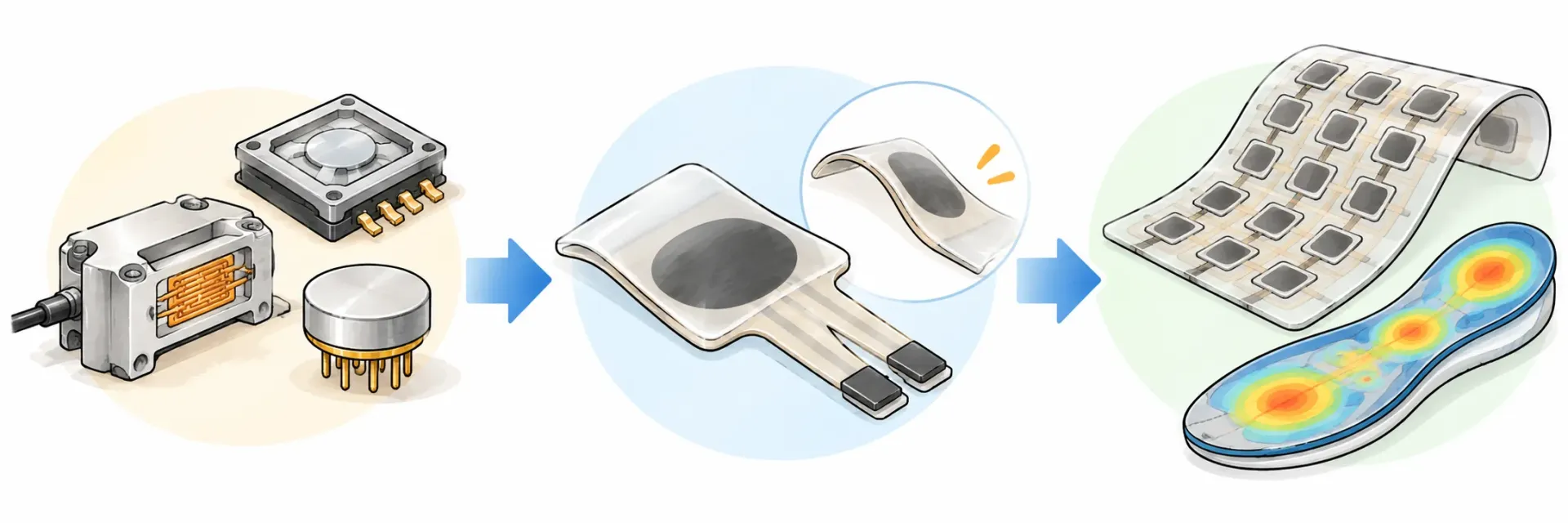
The Evolution of Thin-Film Pressure Sensing Technology: From Traditional Rigid Sensors to Ultra-Thin, Flexible FSR Sensors
To understand the capabilities of FSR thin-film pressure sensors, it is helpful to explore the evolution of sensing materials and structural designs:
\- Traditional Rigid Metal and Silicon-Based Sensors: Early pressure sensing technologies primarily relied on silicon-based MEMS sensors or rigid ceramic diaphragms. Although these technologies offered high measurement accuracy, their rigid structures limited flexibility and made them unsuitable for bending. Integrating them into compact or curved mechanical designs often presented significant challenges.
\- Advancements in Printed Electronics and Conductive Polymer Coatings (Since the 2000s): With improvements in precision screen printing and nanoscale conductive materials, manufacturers developed techniques to apply pressure-sensitive conductive coatings onto flexible polymer substrates, such as PET and PI films. These advancements accelerated the development of flexible thin-film sensing technology, enabling thinner, lighter, and more adaptable sensor designs.
\- Advanced Wearables and Multi-Zone Tactile Sensing (Present Day): In recent years, FSR thin-film pressure sensors have evolved beyond simple single-point switches into multi-zone pressure sensing arrays capable of monitoring dynamic force distribution. These technologies are increasingly used in smart insoles, flexible robotic tactile skins, and medical monitoring systems, expanding the possibilities for intelligent sensing applications.
How FSR Thin-Film Pressure Sensors Work: Understanding Resistance Changes Through a Dual-Layer Structure and Pressure-Sensitive Coating
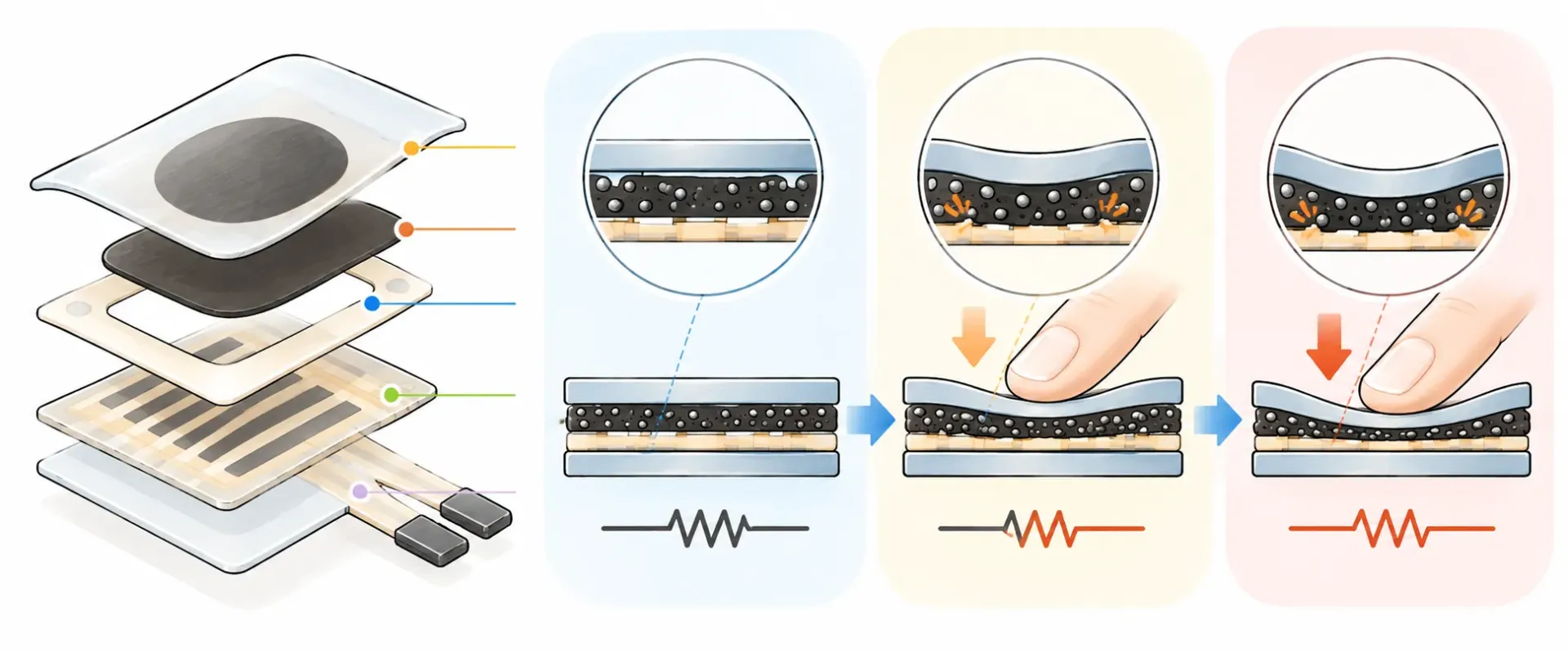
The core operating principle of FSR thin-film pressure sensors is based on changes in electrical resistance caused by variations in the microscopic conductive contact area as force is applied.
The following four key points explain how FSR sensors work and how applied force is converted into measurable electrical signals:
Key Point 1: A Simple Yet Precise Two-Layer Structure
A typical FSR thin-film pressure sensor consists of two main film layers:
-
Top Film: Coated with a specialized pressure-sensitive material (piezoresistive ink or coating).
-
Bottom Film: Printed with an interdigitated electrode pattern (Interdigitated Electrodes).
-
Spacer Layer: A thin adhesive spacer separates the two film layers, preventing them from making contact when no force is applied.
Key Point 2: High Resistance State When No Force Is Applied
When no external force is applied to the sensing area, the pressure-sensitive coating on the top film remains separated from the bottom electrodes or makes only minimal contact.
As a result, the sensor exhibits extremely high electrical resistance (typically greater than 10 MΩ), behaving similarly to an open circuit.
Key Point 3: Increased Microscopic Contact Points Cause Resistance to Decrease
When an external force is applied, such as a finger press, an object being placed on the sensor, or a person stepping on it, the following process occurs:
-
Film Deformation: The top film bends slightly downward under the applied force.
-
Electrical Contact: The pressure-sensitive coating begins to make physical contact with the interdigitated electrodes on the bottom layer.
-
Resistance Reduction: As the applied force increases, more microscopic conductive contact points form, creating additional conductive pathways and causing the electrical resistance to decrease rapidly.
In simple terms:
Greater Applied Force → More Conductive Contact Points → Lower Electrical Resistance
Key Point 4: Converting Resistance Changes into Readable Voltage Signals
Since FSR thin-film pressure sensors respond to applied force through changes in electrical resistance, the system can use a simple voltage divider circuit or an operational amplifier (Op-Amp) to convert these resistance changes into analog voltage signals.
These signals can then be read by a Microcontroller Unit (MCU) through an Analog-to-Digital Converter (ADC), enabling real-time monitoring of applied force.
Depending on the circuit design and supply voltage, the output signal may operate within a range such as 0–5 V, allowing the control system to interpret relative force levels and respond accordingly.
FSR Thin-Film Pressure Sensors vs. Traditional Pressure Sensors: A Comparison of 4 Key Technologies and Performance Characteristics
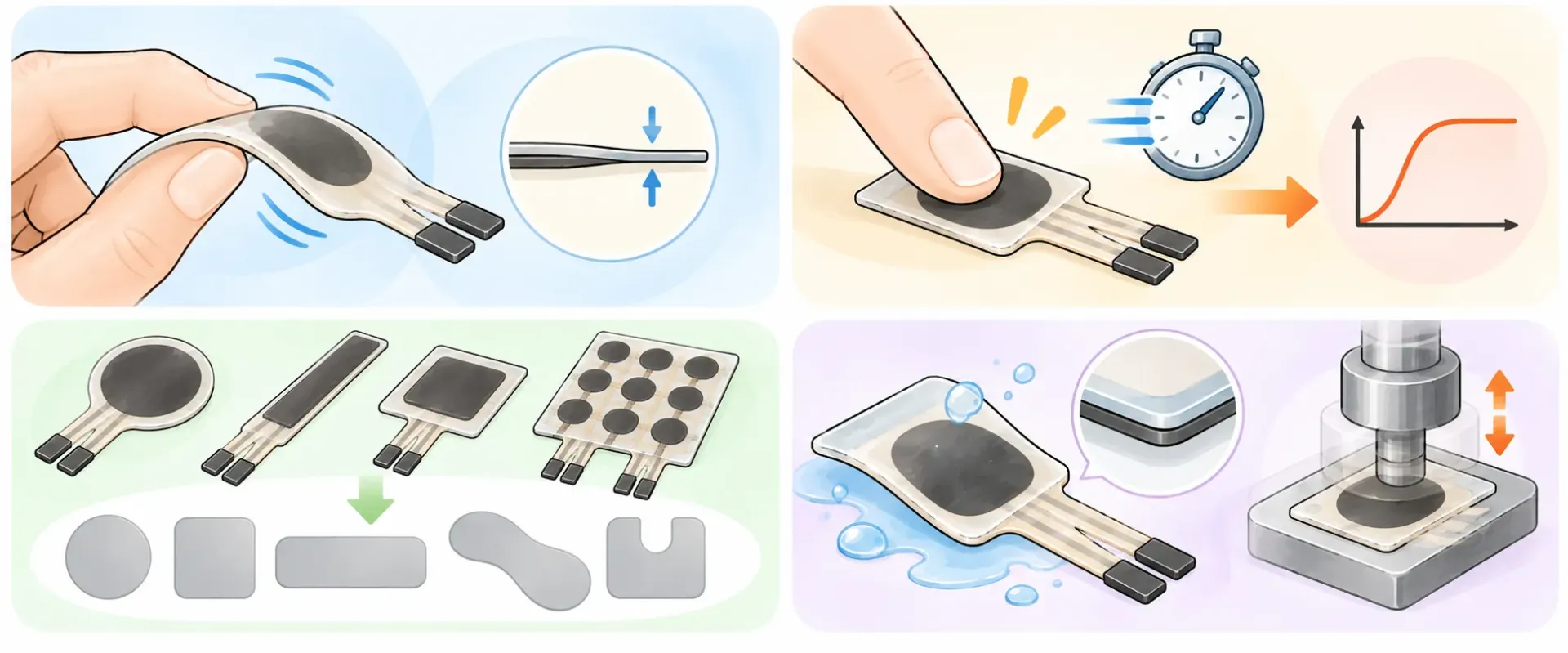
1. Ultra-Thin, Lightweight, and Highly Flexible Design
FSR thin-film pressure sensors typically have a thickness of just 0.1–0.5 mm and offer excellent flexibility. Their thin profiles allow them to conform to curved surfaces and fit easily into wearable device linings or compact spaces within electronic equipment.
2. Low Power Consumption and Fast Response
FSR sensors can consume virtually no power when no force is applied, depending on the circuit design. They also offer fast response times, making them suitable for battery-powered portable devices and wireless IoT applications.
3. Highly Customizable Shapes and Sensing Areas
Thanks to printed electronics technology, FSR sensors can be customized in terms of shape, size, and the number of sensing points, including single-point, multi-point, and matrix configurations.
This design flexibility allows manufacturers to develop sensor solutions tailored to specific project requirements without the high tooling costs typically associated with custom semiconductor chips.
4. High Durability and Environmental Resistance
FSR sensors contain no mechanical wear components such as ball bearings or metal switch springs. Depending on the materials and design, they can withstand millions of actuation cycles.
With appropriate sealing and protective construction, FSR sensors can also provide effective dust and moisture resistance, making them suitable for a wide range of operating environments.
壓力感測技術性能比較表
|
Comparison |
FSR Thin-Film Pressure Sensors |
Traditional Metal Strain Gauges |
MEMS Silicon-Based Pressure Sensors |
|---|---|---|---|
|
Sensing Mechanism |
Resistance changes through microscopic conductive contact |
Resistance changes due to deformation of metal conductors |
Piezoresistive or capacitive sensing through diaphragm deformation |
|
Thickness & Structure |
Ultra-thin (less than 0.5 mm), flexible |
Relatively thick and rigid |
Fixed structure with packaged semiconductor chips |
|
Installation Flexibility |
Very high; conforms to curved surfaces and compact spaces |
Typically bonded to suitable structural surfaces |
Typically mounted on a PCB |
|
Power Consumption |
Near-zero power consumption when no force is applied |
Moderate; requires continuous bridge excitation |
Low to moderate |
|
Key Advantages |
Thin, lightweight, flexible, and highly customizable |
High accuracy and excellent linearity |
Compact size and precise absolute pressure measurement |
|
Common Applications |
Smart insoles, seats, buttons, wearable devices |
Heavy-duty weighing scales, structural stress testing |
Automotive tire pressure monitoring, industrial pneumatic systems |
推薦閱讀:
Industrial Applications of FSR Thin-Film Pressure Sensors: Which High-Performance Products Are Driving Adoption?
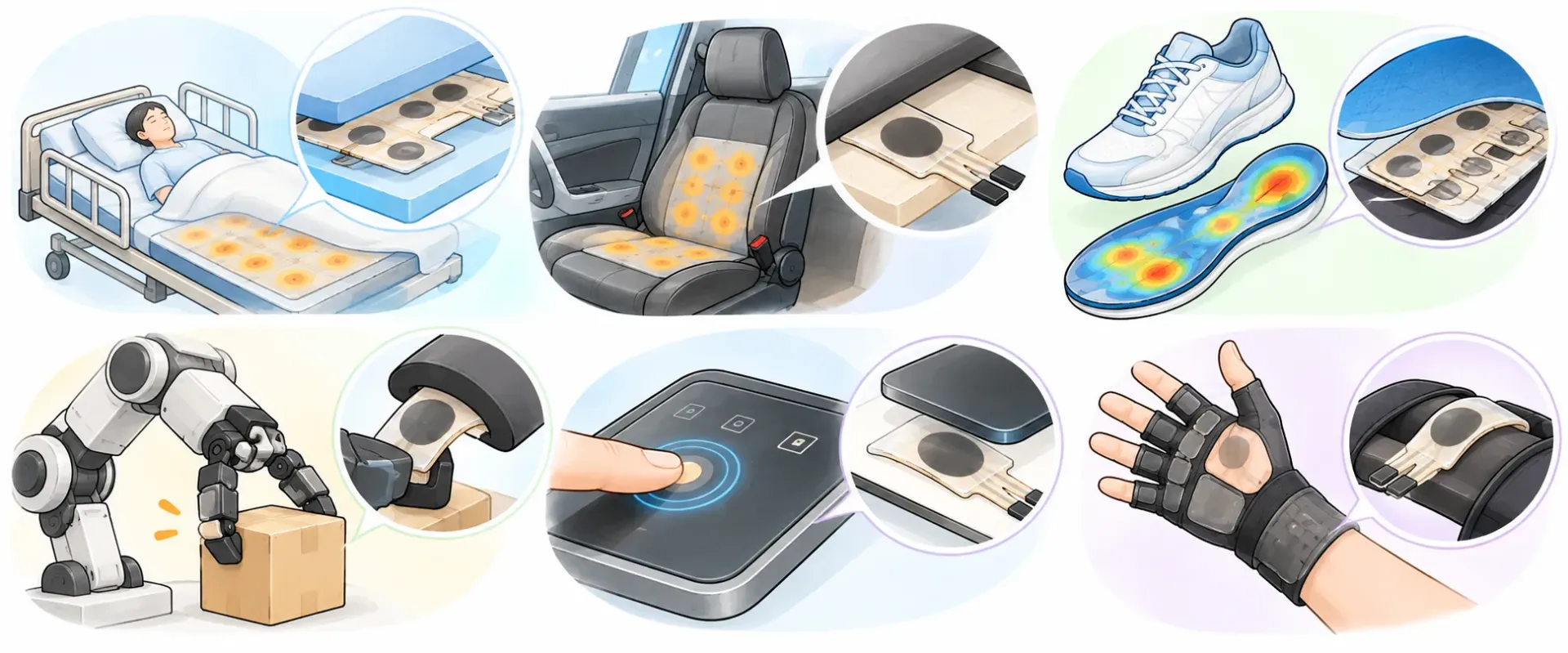
Thanks to their combined advantages of ultra-thin flexibility, low power consumption, and design versatility, FSR thin-film pressure sensors are rapidly expanding into a wide range of industrial applications:
。Smart Healthcare and Patient Monitoring: FSR sensors can be integrated into medical mattresses to monitor the repositioning of bedridden patients, infusion pumps for force monitoring, and rehabilitation equipment to track grip strength and applied force.
。Automotive Safety and Smart Seating Systems: FSR sensors are used in automotive seats for passenger occupancy detection and Seat Belt Reminder (SBR) systems. They can also support Hands-Off Detection (HOD) in steering wheels and anti-pinch protection systems in vehicle doors.
。Sports Technology and Smart Insoles: Thin-film sensor arrays can be embedded into insoles to monitor athletes' running gait, plantar pressure distribution, center of pressure, and impact forces in real time.
。Industrial Robotics and Flexible Tactile Grippers: FSR sensors can be installed on robotic gripper fingertips to provide sensitive force feedback, helping robotic systems adjust gripping force and prevent damage when handling fragile objects.
。Consumer Electronics and Smart Home Appliances: FSR sensors can replace conventional mechanical buttons, enabling advanced control panels with multi-level force sensing (Force Touch). With appropriate sealing and structural design, these interfaces can also provide enhanced water and dust resistance.
Favor Union: Integrating Next-Generation Thin-Film Technology to Deliver High-Quality, Precision FSR Pressure Sensing Modules
Although the operating principle of FSR thin-film pressure sensors is relatively straightforward, manufacturing sensing elements with high resistance repeatability, aging resistance, and consistent trigger force requires extensive expertise in pressure-sensitive ink formulations, precision screen printing, and lamination and encapsulation processes.
With over 40 years of experience in precision control components and printed film circuits, Favor Union continues to advance its capabilities in next-generation thin-film pressure sensing technology:
- Proprietary Material Formulations and Custom R&D: With dedicated materials and mechanical engineering teams, Favor Union provides customized sensor development based on specific application requirements, including trigger force, dynamic range, and sensor geometry.
- Strict International Quality Management: Favor Union's manufacturing facilities comply with ISO 9001 and ISO 14001 quality and environmental management standards. Through automated printing processes and 100% electrical testing, the company works to ensure high reliability, consistent performance, and long-term stability across production batches.
- Made in Taiwan (MIT) Manufacturing Support: For advanced medical, automotive, and defense industry applications, Favor Union can provide Made in Taiwan (MIT) manufacturing solutions to support global supply chain requirements, procurement strategies, and localized production needs.
Interested in next-generation FSR thin-film pressure sensing technology, or developing a project with specific sensor requirements?
Visit the Favor Union to submit your inquiry. Our professional technical and engineering teams are ready to assist with sensor selection, customized development, and sample evaluation to help you find the right solution for your application.