

How Do Pressure Sensors Work? A Simple Guide to Sensing Principles
How Do Pressure Sensors Work? A Simple Guide to Sensing Principles
In smart medical devices, industrial automation equipment, automotive systems, and consumer electronics, accuracy, reliability, and slim designs have become key priorities for hardware development teams. Although pressure is invisible, electronic devices can accurately detect pressure changes inside pipelines, measure the force applied by a fingertip, and even identify foot pressure and contact positions. The key lies in pressure sensors, which convert external forces into electrical signals that electronic systems can read and interpret.
However, pressure sensors operate through different sensing mechanisms. Some sensors change their electrical resistance when pressure is applied, while others use diaphragm displacement to change capacitance. Certain materials generate electrical charges when subjected to mechanical force. Meanwhile, Force Sensing Resistors (FSRs), commonly used in smart insoles, seats, buttons, and wearable devices, detect applied force through changes in their electrical conductivity.
This article explores the evolution of pressure sensor technology, sensing mechanisms, differences in operating principles, and industrial applications, providing a comprehensive understanding of this essential technology.
The Evolution of Pressure Sensing Technology:
From Traditional Metal Strain Gauges to Thin-Film FSR Sensors
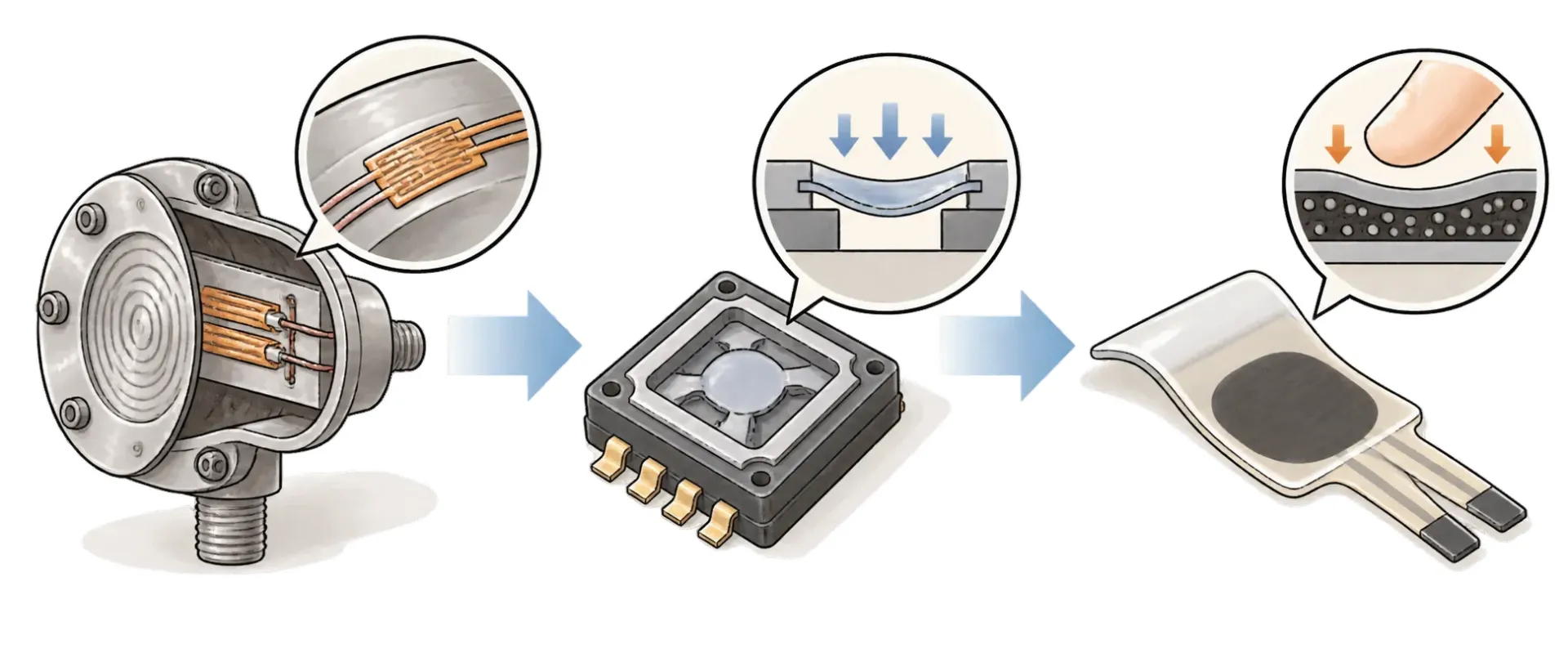
To understand the capabilities of pressure sensing technology, it is helpful to look at the evolution of sensing materials and structural designs. Pressure measurement technology originally emerged from industrial needs to monitor the safety of mechanical structures. Over several decades, it has undergone significant technological advancements:
。Traditional Metal Strain Gauges and Mechanical Diaphragms: Early pressure sensing technologies primarily relied on the mechanical deformation of metal wires or foil strain gauges to detect applied force. Although these methods offered stable performance, early designs were often bulky, had limitations in sensitivity, and could experience material fatigue under repeated high-frequency loading.
。Semiconductor and MEMS-Based Piezoresistive/Capacitive Sensors: With advancements in Micro-Electro-Mechanical Systems (MEMS) manufacturing, silicon-based piezoresistive and capacitive sensing elements became widely adopted in automotive Tire Pressure Monitoring Systems (TPMS), industrial pipelines, and pneumatic pressure monitoring. These technologies enabled higher measurement accuracy and miniaturization.
。Advanced Flexible and Thin-Film Sensors (Present Day): In recent years, advancements in pressure-sensitive polymer materials and printed electronics have accelerated the development of thin-film pressure sensors, including Force Sensing Resistors (FSRs). Their ultra-thin profiles, flexibility, and high customization potential have opened up new possibilities for wearable devices, human-machine interfaces (HMIs), and smart medical applications.
How Pressure Sensors Work: The 4 Stages of Converting Physical Force into Electrical Signals
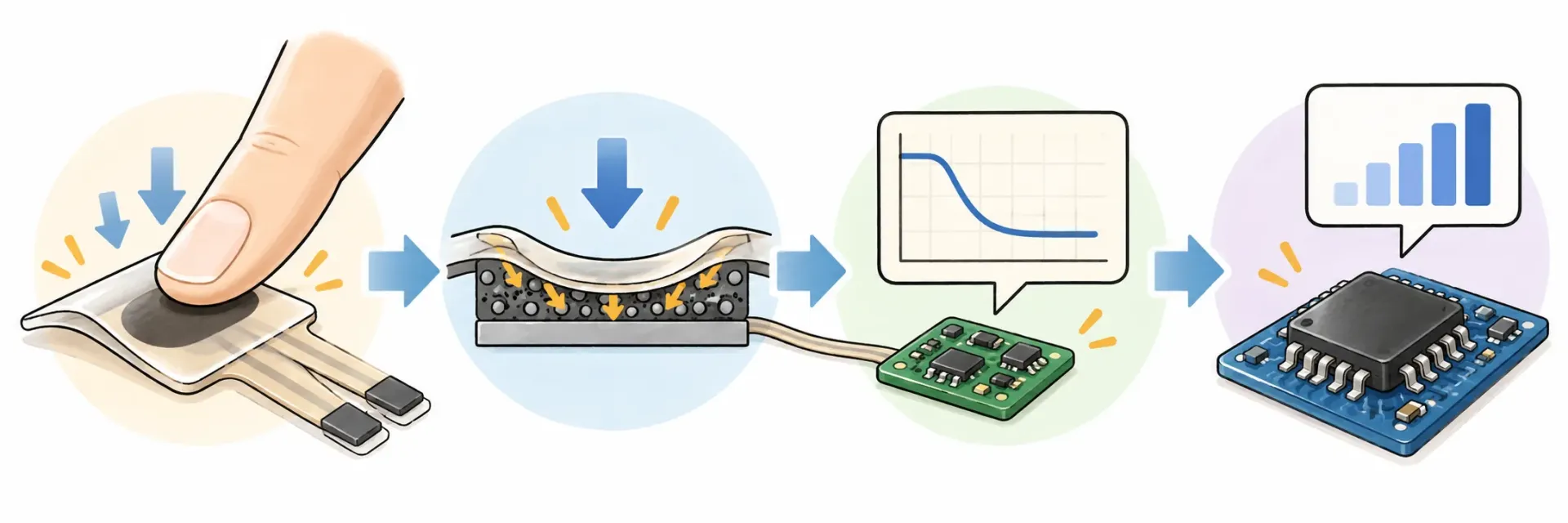
Although pressure sensors vary in structure and sensing technology, most pressure sensing processes can be divided into the following four stages:
- External Force Is Applied to the Sensing Area: Pressure may come from gases, liquids, body weight, finger presses, or mechanical impacts. The type of force being measured directly influences which sensing principle is most suitable for the application.
- The Sensing Element Undergoes a Physical Change: When an external force is applied, the sensing element responds through changes in electrical resistance, capacitance, electric charge, or slight diaphragm deformation, depending on the sensor technology.
- Physical Changes Are Converted into Readable Signals: Internal or external circuits detect and process these changes. In practical applications, additional processes such as signal amplification, filtering, Analog-to-Digital Conversion (ADC), and temperature compensation may be used to ensure stable and reliable signal output.
- The Control System Interprets the Signals: Finally, the signals are transmitted to an MCU, PLC, or other controller, allowing the system to determine pressure values, detect button activation, evaluate applied force levels, or identify foot pressure locations.
The core concept is straightforward:
External Pressure → Physical Change in the Sensing Element → Electrical Signal Conversion → Control System Interpretation
Comparing Common Pressure Sensor Technologies:
Piezoresistive, Capacitive, Piezoelectric, and FSR Sensors
The four most common pressure sensing technologies are described below, each with its own operating principles and suitable applications.
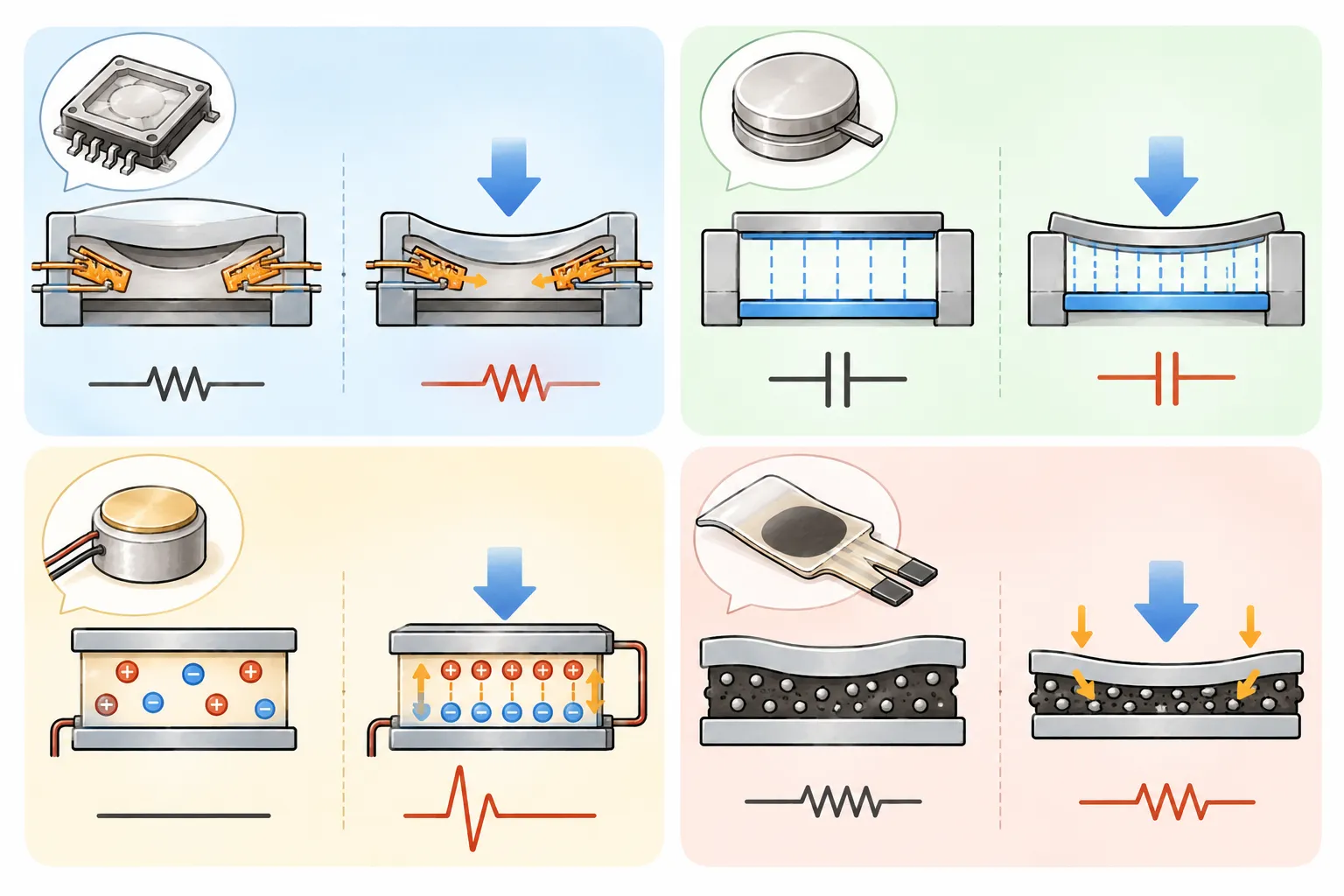
1. Piezoresistive Sensors: Resistance Changes Under Applied Pressure
Piezoresistive sensors operate based on the principle that a material's electrical resistance changes when subjected to mechanical stress. When gas or liquid pressure is applied to the sensing diaphragm, the diaphragm deforms, causing the piezoresistive elements to stretch or compress, resulting in a change in electrical resistance.
- Key Features: Mature technology, reliable static pressure measurement, and suitable for gas and liquid pressure sensing.
2. Capacitive Sensors: Detecting Changes in Electrode Distance
Capacitive pressure sensors contain two closely positioned electrodes. When external pressure causes the sensing diaphragm to move, the distance between the electrodes changes, resulting in a corresponding change in capacitance.
- Key Features: High sensitivity, low power consumption, and suitable for measuring small pressure differences and use in energy-efficient devices.
3. Piezoelectric Sensors: Generating Electrical Charge Under Force
Piezoelectric sensors use materials that exhibit the piezoelectric effect. When these materials are subjected to compression, impact, or vibration, they generate electrical charges in response to the applied mechanical force.
- Key Features: Extremely fast response times, ideal for detecting rapidly changing dynamic forces, but generally unsuitable for long-term static pressure measurement.
4. FSR Thin-Film Pressure Sensors (Force Sensing Resistors): Resistance Decreases as Applied Force Increases
FSR sensors consist of thin-film layers, electrodes, and pressure-sensitive materials. When no force is applied, the sensor maintains high electrical resistance. As external force increases, the conductive contact area within the sensor increases, causing its electrical resistance to decrease.
- Key Features: Thin, lightweight, flexible, and highly customizable in shape and size. Particularly suitable for detecting contact and relative force levels on human bodies or object surfaces.
Comparison Table of Common Pressure Sensing Technologies
|
Comparison |
Piezoresistive |
Capacitive |
Piezoelectric |
FSR Thin-Film Sensors |
|---|---|---|---|---|
|
Sensing Mechanism |
Resistance changes under applied stress |
Capacitance changes as electrode spacing varies |
Generates electrical charge under mechanical force |
Resistance decreases as conductive contact increases |
|
Suitable for Detecting |
Static and general dynamic pressure |
Small pressure changes and differential pressure |
Impact, vibration, and rapid force changes |
Contact, pressing, and relative force |
|
Primary Measurement Targets |
Gases and liquids |
Gases and small pressure differences |
Dynamic impact forces |
Forces applied to human or object surfaces |
|
Key Features |
Mature technology, widely used |
High sensitivity, low power consumption |
Extremely fast response time |
Thin, flexible, and easy to integrate |
|
Common Applications |
Pipelines, hydraulic systems, tire pressure monitoring |
Air pressure monitoring, HVAC, medical devices |
Impact testing, vibration monitoring |
Smart insoles, seats, buttons, wearable devices |
Recommended Reading:
Industrial Applications of Pressure Sensors: Which High-Performance Products Are Driving Adoption?
With the combined advantages of high accuracy, low power consumption, thin and lightweight designs, and environmental durability, pressure sensing technology is rapidly expanding into a wide range of applications:
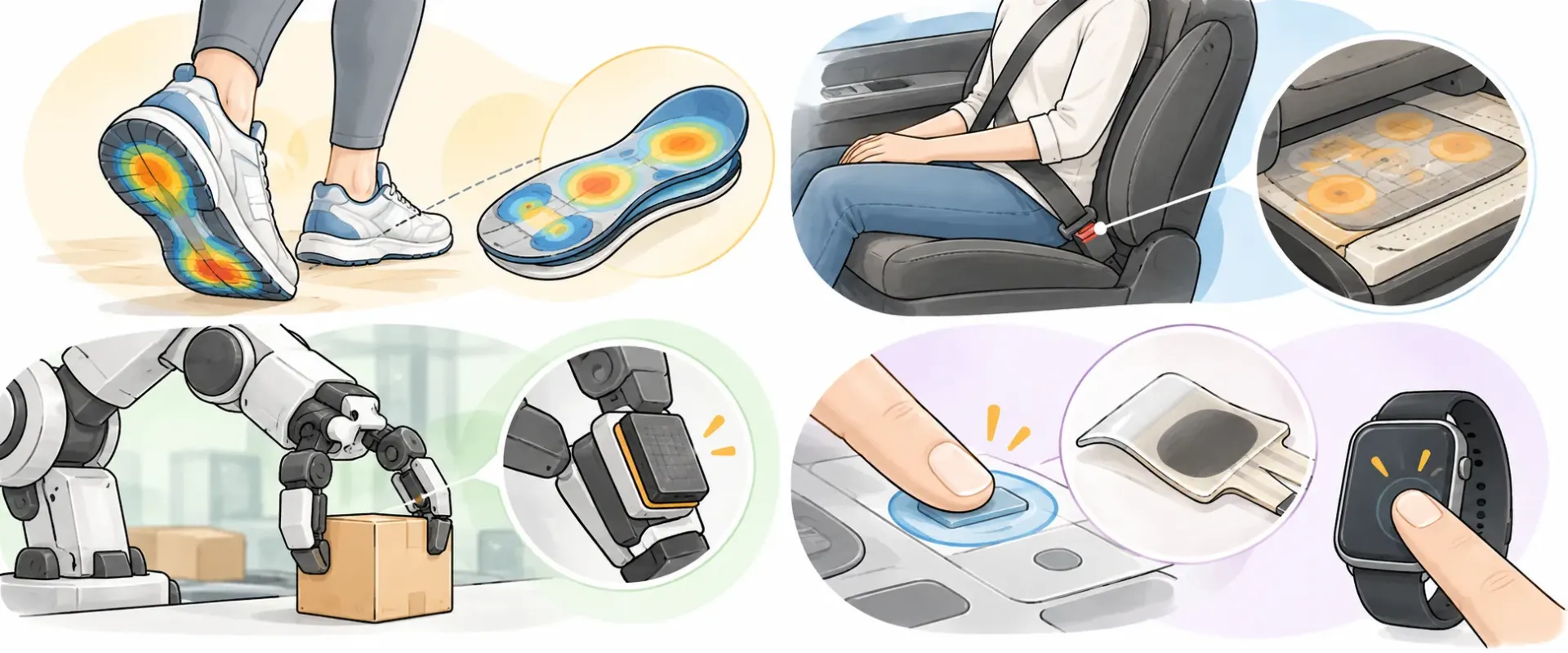
- Smart Insoles and Sports Health Monitoring: The thin and flexible properties of FSR sensors allow them to be integrated into smart insoles to monitor plantar pressure distribution, gait patterns, and impact forces during physical activity in real time.
- Automotive and Smart Seat Sensing: Pressure sensors are used in automotive seats for Seat Belt Reminder (SBR) systems and passenger occupancy detection. They are also integrated into medical mattresses to monitor patient movement and repositioning during prolonged bed rest.
- Industrial Automation and Robotic Tactile Sensing: Robotic arms require accurate force feedback to prevent damage when gripping objects. Thin-film pressure sensors provide responsive tactile sensing, helping robotic systems detect contact and adjust gripping force.
- Human-Machine Interfaces (HMIs) and Consumer Electronics: Pressure-sensitive membrane buttons can replace conventional mechanical switches, enabling multi-level force detection and accidental-touch prevention. These solutions are widely used in wearable devices and medical control panels.
Favor Union:
Integrating Next-Generation Thin-Film Sensing Technology to Develop High-Quality, Precision Pressure Sensing Modules
Although the basic principles of pressure sensing are relatively straightforward, developing a sensing component with stable sensitivity, high durability, and seamless integration into limited mechanical spaces requires extensive manufacturing expertise in material formulation, printing processes, and structural design.
With over 40 years of experience in precision control components and thin-film circuitry, Favor Union continues to advance its development of FSR (Force Sensing Resistor) thin-film pressure sensing technology:
-
Custom R&D and Structural Design: Our dedicated sensing material and mechanical engineering teams support customized sensor designs based on project requirements, including sensing areas, dimensions, shapes, trigger force, and resistance output characteristics.
-
International Quality Standards: Our manufacturing facilities operate under ISO 9001 and ISO 14001 certified management systems, supporting consistent production quality, repeatability, and reliability across thin-film sensing components.
-
Made in Taiwan (MIT) Manufacturing Support: For demanding medical, industrial, and consumer electronics applications, Favor Union can provide Taiwan-based manufacturing solutions to meet the sourcing and supply chain requirements of global customers.
Interested in next-generation FSR thin-film pressure sensing technology, or developing a project with specific sensing requirements?
Visit the Favor Union and submit your inquiry. Our technical and engineering teams are ready to provide personalized sensor selection guidance, customization support, and sample evaluation assistance to help you find the right solution for your application.